
A small business with twelve employees receives about forty calls a day. The manager answers between meetings, misses one prospect out of three, and eventually looks for a service provider to outsource her phone system. The first instinct: compare the displayed prices. The problem is that the rate announced on the homepage almost never corresponds to the actual invoice.
Discrepancy between displayed rate and actual invoice of an outsourced phone system
This is evident with every first quote: the basic subscription seems affordable. A few dozen euros per month, sometimes less than fifty euros excluding tax. This amount covers a limited volume of calls, often well below the actual consumption of an active business.
The bill increases with the unit price for each additional call. According to the public pricing grids of several providers, this cost ranges from less than one euro to more than two euros per call handled. For an organization that receives around a hundred calls monthly, the difference between two providers can double the bill at the same volume.
Before comparing, one must make a precise diagnosis of their own flow. How many incoming calls per week, at what times, with what level of qualification expected. Without this basis, the rate of an outsourced phone system remains an abstraction impossible to evaluate.

Billing models for a phone system: flat rate, per call, or time spent
Three billing modes dominate the market. One does not choose the cheapest at first glance; one chooses the one that fits their activity.
Flat rate billing
A fixed monthly price for a defined volume of calls. The operation is predictable, the budget controlled. The risk: paying for unused calls during quiet months, or exceeding the flat rate during busy months with overages charged at a high price.
Pay-per-call or per-action billing
Each answered call is billed individually. This model suits businesses whose volume fluctuates significantly (seasonal activity, construction trades). You only pay for what is actually handled, but the bill becomes difficult to anticipate.
Time-based billing
The provider bills by the minute of conversation. This mode penalizes long calls (complex appointment scheduling, technical qualification) and favors short flows. It is common in medical or legal tele-secretarial services.
The choice of model depends on a single parameter: the regularity of the call flow. A law firm with a stable volume each month benefits from the flat rate. A plumber whose activity doubles between November and March is better off paying per action.
Hidden costs in a telephone answering service contract
The price of the call does not summarize the expense. Several lines appear on the first invoice without having been clearly announced at the time of the quote.
- Setup and configuration fees: configuring the welcome script, line transfer, integration with a calendar or CRM. These initial fees sometimes represent the equivalent of one to two months of subscription.
- Hourly surcharges: managing calls outside standard working hours (evenings, weekends, holidays) is almost always billed additionally, with a higher unit rate.
- Reporting and supervision options: some providers charge for access to a detailed dashboard or for sending call reports by email.
- Contractual commitment and termination penalties: contracts with a commitment of six or twelve months include early exit fees that increase the total cost if the service is not suitable.
Requesting a detailed quote with a simulation based on actual volume remains the only reliable way to assess the complete cost. Feedback varies on this point, but most providers accept a one-month trial period without long-term commitment.
Outsourced phone systems and obligations related to the AI Act for businesses
Since some providers offer callbots or voice agents on the front line, a new parameter enters the pricing equation. The European AI Act, which is set to be fully implemented by August 2, 2026, requires that a person be informed when interacting with an artificial intelligence system.
For a business that outsources its phone reception, this means that the provider must announce the non-human nature of the agent at the beginning of the exchange. The welcome script lengthens, human supervision remains necessary in the background, and compliance documentation (traceability of actions, control of data access) generates additional costs.
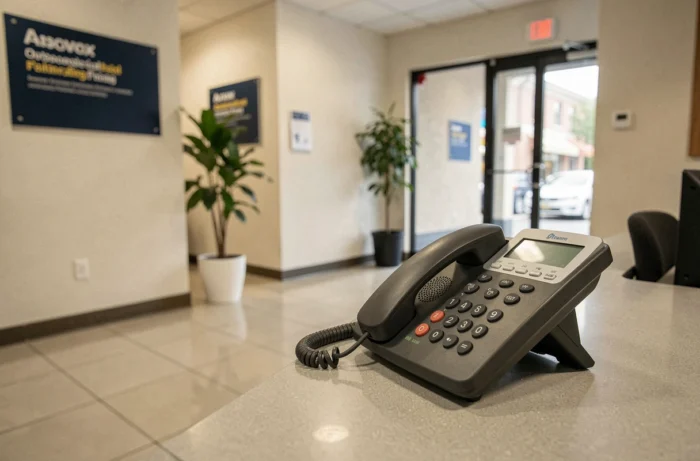
A 100% AI phone system looks cheaper on paper. In practice, regulatory compliance costs reduce the gap with a human service. It is also essential to verify whether the provider covers this compliance in their contract or if it remains the client’s responsibility.
Selection criteria beyond price for a business phone system
Price alone is not enough to distinguish between two offers. Three operational criteria weigh as much as price in daily satisfaction.
The first is the provider’s ability to distinguish and qualify calls. A service that merely takes messages does not hold the same value as one capable of filtering emergencies, transferring to the right contact, and feeding a CRM. This qualification comes at a cost, but it prevents losing clients.
The second concerns the actual operating hours. A provider covering from 8 AM to 7 PM on weekdays does not meet the same need as a 24/7 phone answering service. One must consider this coverage in relation to their own clients’ behavior: a B2B company whose calls concentrate between 9 AM and 5 PM has no reason to pay for nighttime coverage.
The third is the transparency of reporting. Knowing how many calls were answered, in what time frame, with what successful transfer rate, allows for service adjustments month after month and renegotiation if results do not follow.
Comparing quotes for outsourced phone services without these three criteria is akin to choosing a supplier based solely on their logo. The monthly rate is just a starting point: it is the cost per useful call, related to the quality of handling, that determines the actual profitability of the service for the business.