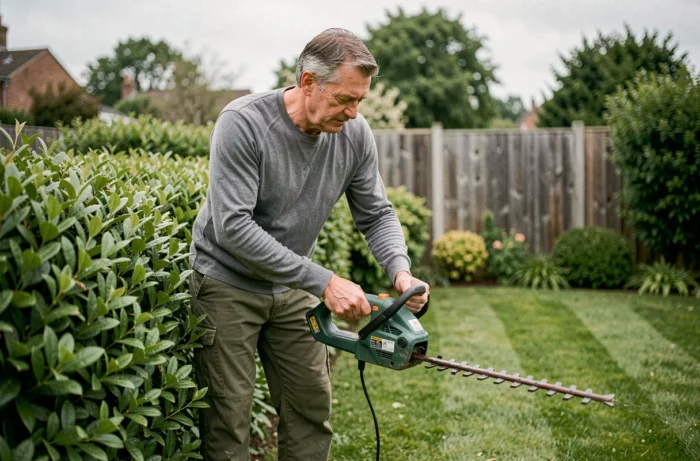
A hedge of palm laurels that has exceeded the fence for two seasons, branches over one centimeter in diameter, and an old corded hedge trimmer that jams every five minutes: this is often the situation that triggers the purchase of a new device. The choice of a suitable hedge trimmer depends less on the brand than on the hedge itself, its density, height, and cutting frequency.
Battery platform: the real choice to make before the hedge trimmer
We rarely start there, and it’s a mistake. The battery often represents between 30 and 50% of the total kit price (tool, battery, charger). Over five years, this is the most significant item in the budget, not the hedge trimmer itself.
Major brands offer common platforms in 18 V or 36 V. The principle is simple: the same battery powers the hedge trimmer, lawn mower, blower, and brush cutter. When you already own a battery tool from a specific brand, it is often more cost-effective to stay within the same ecosystem rather than searching for the best hedge trimmer across all brands.
Feedback varies on this point, but some users notice significant differences in autonomy between two tools from the same platform. The explanation lies in the torque required: a hedge trimmer demands less from the battery than a lawn mower, so the same 36 V cell will last longer. A detailed selection can be found on taille-haie-warrior.com, which classifies models by platform type and usage.

Tooth spacing and cutting diameter: the criteria that labels hide
Power in watts or volts catches the eye on the shelf. In practice, the spacing of the teeth on the blade determines the maximum cutting diameter. A tight spacing (around two centimeters) is suitable for young and thin hedges, like privet or boxwood. For cherry laurel or established hornbeam, a wider spacing is necessary, capable of handling thicker branches without jamming.
The problem: this information is not always on the packaging. It can be found in the technical sheet, sometimes under the term “cutting capacity” or “maximum cutting diameter.” Before purchasing, measure a few branches on your hedge with a tape measure. It’s more reliable than relying on the “heavy-duty” mention printed on the box.
Blade length according to hedge width
A short blade (around 45 cm) is easy to handle on a narrow hedge or topiary. For a fence hedge exceeding 60 cm in width, a longer blade is needed, which covers the width in a single pass. Choosing a blade that is too long for a small hedge makes the tool heavy and imprecise.
Gas, corded, or battery hedge trimmer: the terrain decides
Guides often rank the three types side by side as if they were equal. In practice, the consumer market has largely shifted towards battery in recent years. More than 60% of new motorized garden tools sold in France are now battery models. Gas remains relevant in a specific case: long, dense hedges with thick branches, where the autonomy and torque of the gas engine make a difference.
The corded option still holds interest for a tight budget and a hedge close to the house. You plug it in, trim, and it’s done. But as soon as you exceed twenty linear meters or need to navigate around an obstacle, the extension cord becomes a real safety and comfort issue.
- 18 V battery: fine to medium hedges, regular maintenance, less than three meters high. Lightweight, quiet, immediate start.
- 36 V battery or more: medium to dense hedges, branches up to two centimeters, longer cutting sessions without loss of power.
- Gas: long hedges (several dozen linear meters), thick branches, areas without electrical access. Noisier, heavier, requires regular engine maintenance.
- Corded: small hedges near a socket, limited budget, occasional use. Constant power as long as plugged in.
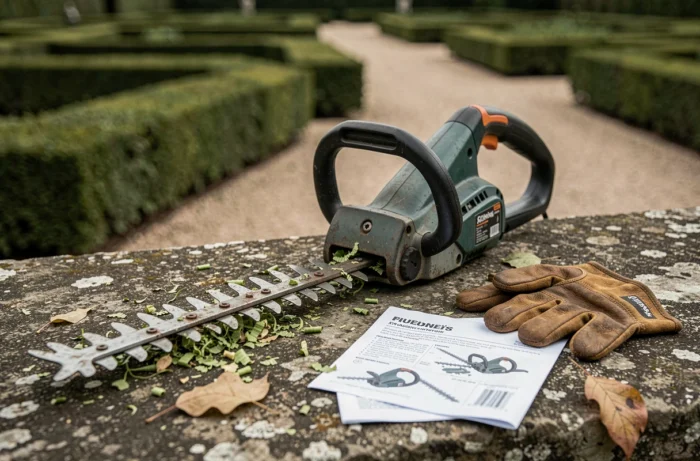
Weight and balance of the hedge trimmer: what really tires the arms
A hedge trimmer is held at arm’s length, often above the head for the upper parts. The total weight including the battery matters more than the “dry” weight displayed on the product sheet. A model advertised at three kilograms can weigh almost five once the battery is attached.
The balance of the device is as important as the gross weight. A hedge trimmer with its center of gravity towards the back (motor side) forces the wrist to constantly compensate. Models with a rotating handle allow trimming the sides and top without twisting the wrist, which significantly reduces fatigue during a session of an hour or more.
Vibrations and long sessions
The European standard regulates the levels of vibrations transmitted to the hands. In practice, brushless motors transmit less vibration than carbon motors, and gas models vibrate more than electric ones. On a fence hedge that requires two hours of work, this parameter changes the game for the joints.
Trimming period and regulations: a calendar to respect
The French Office for Biodiversity recommends avoiding any hedge trimming between March 15 and July 31, during the bird nesting period. This recommendation applies not only to rural or countryside hedges but also to subdivision gardens.
In practice, trimming is done at the end of winter (February-March, before nesting) and at the end of summer (September-October). This calendar reduces cutting sessions to two or three interventions per year, which also lightens the autonomy constraints for a battery model.
The choice of hedge trimmer ultimately boils down to three concrete questions: what diameter of branch to cut, what length of hedge to treat in one session, and in which battery ecosystem one is already engaged. Answering these three points before looking at prices avoids most bad purchases.


