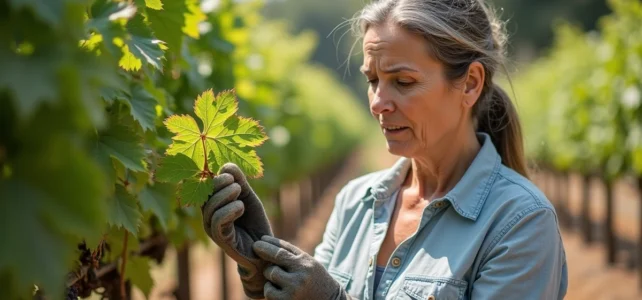
The trio of downy mildew, powdery mildew, and botrytis accounts for almost all fungal damage on garden vines. Effectively treating these vine diseases requires understanding local fungal pressure, adapting the intervention schedule, and choosing the right molecules or biological alternatives, without repeating common dosage errors made by amateurs.
Copper restrictions in the garden: what changes for Bordeaux mixture
European regulations now cap the copper dose at 4 kg per hectare per year in organic farming. This limit, designed for professionals, is also reflected in recommendations for family gardens. In practical terms, this means that Bordeaux mixture can no longer be applied systematically with every rainy episode.
We recommend reserving copper for critical phenological stages: bud break, pre-flowering, and cluster closure. Outside of these windows, the risk of accumulation in the soil outweighs the fungicidal benefit. Treatments should be carried out early in the morning or in the evening to limit phototoxicity on young leaves and maximize product adherence.
To learn how to treat vine diseases while respecting these new constraints, it is necessary to rethink the classic schedule and split doses rather than applying a high concentration in one go.
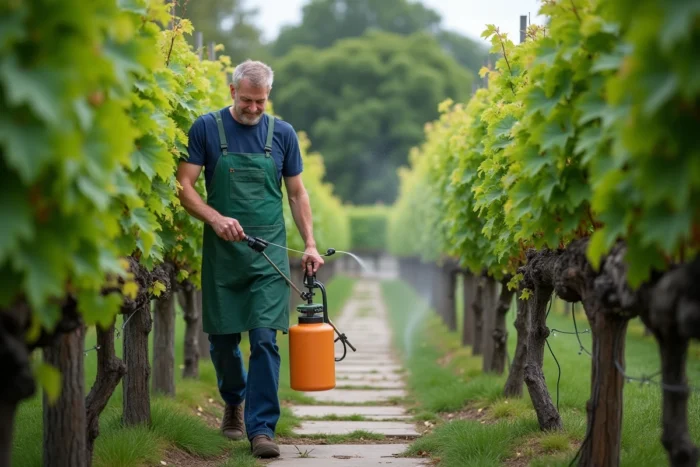
Wettable sulfur against powdery mildew: dosage and effectiveness conditions
Sulfur remains the reference molecule against Erysiphe necator, the agent of powdery mildew. Its mode of action by contact and gaseous sublimation makes it effective as long as a precise temperature range is respected. Below 18 °C, sublimation is insufficient. Above 30 °C, the risk of leaf burn becomes real.
The wettable form, diluted and sprayed, offers better coverage than powdered sulfur on garden trellises, where the foliage is often dense and poorly aerated. We observe that most failures in sulfur treatments result from late application, when the white felt is already visible. At this stage, the fungus has penetrated the epidermis and sulfur can only act preventively on still healthy organs.
Combining sulfur and aeration pruning
No fungicide compensates for a lack of air circulation. On a trained or pergola vine, leaf removal in the fruiting zone reduces humidity around the clusters. This mechanical intervention, carried out on the shaded side after fruit set, significantly decreases powdery mildew pressure and allows for a reduction in the number of sulfur applications.
Alternatives to Bordeaux mixture: bicarbonate and horsetail
In light of the structural reduction of copper, two alternatives are gaining credibility for the knowledgeable gardener.
- Sodium or potassium bicarbonate, sprayed at a rate of a few grams per liter of water, alters the surface pH of the leaves and inhibits the germination of downy mildew and powdery mildew spores. Its effectiveness is documented on vegetable crops (tomato, zucchini) and is transferable to garden vines, provided that applications are renewed after each rain.
- Horsetail decoction (Equisetum arvense), rich in silica, strengthens the cell wall of the leaves. It acts as a natural defense stimulator rather than a direct fungicide. Its interest lies in prevention: applied at bud break, it reduces the foliage’s receptivity to primary infections.
- White mixture (based on slaked lime) is sometimes cited as a substitute for copper. It forms a protective film on the foliage, but its persistence is low and its effectiveness against downy mildew remains inferior to that of Bordeaux mixture.
These solutions do not replace a copper treatment in years of high pressure, but they allow for spacing out applications and staying within regulatory limits.

PIWI resistant grape varieties: reducing treatments at the source
The best long-term strategy for a garden is to plant varieties that are genetically resistant to downy mildew and powdery mildew. The so-called PIWI varieties (from the German pilzwiderstandsfähig, “fungus-resistant”) are the result of interspecific crossings between Vitis vinifera and American or Asian species carrying resistance genes.
Among the varieties suitable for gardens, there are table and wine grapes that require only one to two treatments per season instead of ten for a classic variety. This varietal choice is particularly relevant for ornamental trellises or arbors, where regular spraying of fungicides is burdensome and undesirable near living areas.
Limitations of PIWI in the garden
Resistance is not absolute. Some PIWI remain sensitive to black rot or botrytis. We recommend maintaining an aerated pruning and regular visual monitoring even on these varieties. The circumvention of resistances by new strains of Plasmopara viticola is a documented phenomenon in professional viticulture, and varietal diversity remains the best assurance against this risk.
Vine treatment schedule in the garden: key stages
An effective treatment relies less on the chosen product than on respecting intervention windows. Here are the phenological stages to target:
- Bud break (swollen buds, visible green tips): first copper treatment or horsetail decoction. The goal is to protect young shoots from primary downy mildew infections.
- Pre-flowering (separate inflorescences): treatment with wettable sulfur against powdery mildew. Partial leaf removal in the fruiting zone if the foliage is dense.
- Cluster closure (the berries touch): last fractionated copper treatment. This is the critical period for botrytis, favored by humidity trapped between the berries.
- Veraison (color change of the berries): stop chemical treatments, even “organic.” Only monitoring and manual removal of affected clusters remain.
Treating between these stages, “just in case,” amounts to wasting product and unnecessarily loading the soil with residues. Garden vines, unlike vineyard plots, can be visually monitored every day, allowing for precise interventions rather than systematic anticipation.