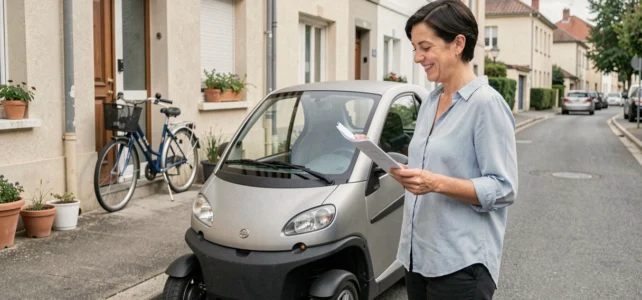
A new light quadricycle costs several thousand euros, and even used ones remain expensive for tighter budgets. Obtaining a light quadricycle for free is less about luck and more about a methodical approach: donations between individuals, combined social aids, or professional integration schemes can, in some cases, cover the entire acquisition cost of a light quadricycle.
Donation of a light quadricycle between individuals: the legal framework to respect
The donation remains the only way to acquire a light quadricycle without spending a dime. Individuals give away their vehicle after losing their driving license, a change in family situation, or simply because the vehicle is aging. These offers can be found on Le Bon Coin (filter by “light quadricycle” and then sort by ascending price), on Facebook groups dedicated to light quadricycles, and on regional automotive forums.
The free transfer requires the same administrative formalities as a traditional sale. The donor must complete a transfer certificate (cerfa 15776), provide a technical inspection that is less than six months old, and hand over the crossed-out registration document with the mention “transferred on” followed by the date and their signature. The beneficiary then has one month to request a new registration document in their name.
Knowing how to obtain a free light quadricycle also involves checking the actual condition of the offered vehicle. A light quadricycle given for free may hide restoration costs that negate the initial savings: non-functioning battery, worn engine parts, tires to be replaced.
Technical precautions before accepting a light quadricycle donation
A valid technical inspection does not guarantee the absence of short-term expenses. Light quadricycles rely on low-displacement diesel or gasoline engines, and their spare parts can sometimes be more expensive, relative to the vehicle’s price, than those of a traditional city car.
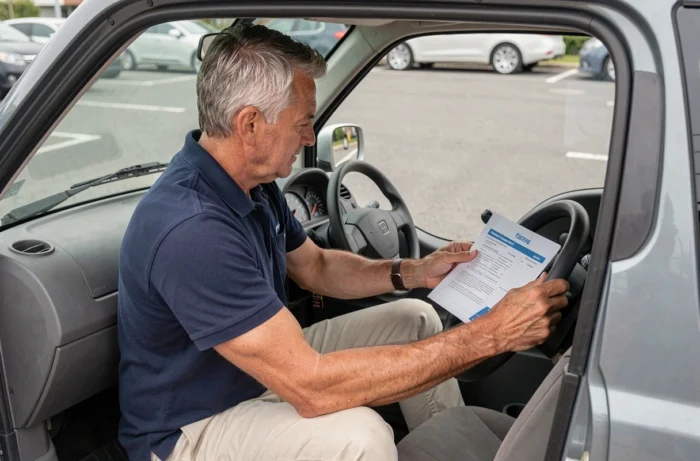
Before accepting a donation, a targeted inspection can help avoid unpleasant surprises:
- Check the condition of the timing belt or chain depending on the model (Aixam, Ligier, Microcar): its replacement represents a significant portion of the value of a used light quadricycle.
- Verify the actual mileage on the odometer and cross-check it with the maintenance history. A vehicle given “for free” with high mileage and no maintenance log indicates a risk of rapid engine failure.
- Examine the ABS plastic bodywork: structural cracks cannot be repaired; they require the complete panel to be replaced.
- Test the braking system and steering. On a light quadricycle limited to 45 km/h, failing brakes endanger the driver just as much as in a traditional car.
If the vehicle requires major repairs, request a quote before the transfer. A donation that comes with repairs costing several hundred euros is no longer truly free.
Social aids and mobility funds: financing a light quadricycle with no out-of-pocket costs
No national aid fully finances the purchase of a light quadricycle. The conversion bonus and ecological bonus exclude thermal light quadricycles from their scope. Aids that come close to total financing are local and conditioned on an integration project.
CAF mobility loan
Some Family Allowance Funds offer a zero-interest or very low-interest loan intended for the purchase of a vehicle for beneficiaries in precarious situations. This CAF mobility loan is capped at a few thousand euros and subject to a social file review. It generally does not cover the entire price of a new light quadricycle but may suffice for a used vehicle in good condition.
Allocation depends on the departmental fund: not all offer this scheme, and conditions vary from one department to another. Contact your local CAF directly to verify the existence of the loan and its limits.
Youth aid fund and departmental mobility funds
Departmental councils manage mobility funds aimed at individuals engaged in employment or training pathways. France Travail directs job seekers to these schemes, which can take the form of direct aid for purchasing a vehicle or covering mobility-related expenses.
For those under 25, the Youth Aid Fund (FAJ) represents another avenue. Its amount remains modest, but combined with a CAF loan and a partial donation, it can reduce the out-of-pocket cost to zero for a used light quadricycle.
Combining aids and strategy to achieve a zero cost
Obtaining a light quadricycle without paying anything requires combining several levers. The combination of a CAF loan, a departmental mobility fund, and a low-priced used purchase constitutes the most realistic scenario for low-income households.
Some regions have recently launched mobility eco-vouchers covering a fraction of the price of a used electric vehicle for low-income households. These schemes do not specifically target thermal light quadricycles, but used electric quadricycles may be eligible. Check the conditions with your regional council.
The current logic of public aids prioritizes “insertion mobility”: each scheme requires an ongoing professional or training project. A request without proof of employment or training is unlikely to succeed, regardless of the applicant’s income level.
The used market for light quadricycles remains narrow in France, with fewer offers than for traditional city cars. Regularly monitoring listings, expanding the geographical scope, and accepting older models (Aixam, Ligier, Microcar from previous generations) increases the chances of finding a vehicle at a very low price.
A well-maintained light quadricycle with reasonable mileage remains a reliable means of transportation, even when acquired for a modest sum or through donation.