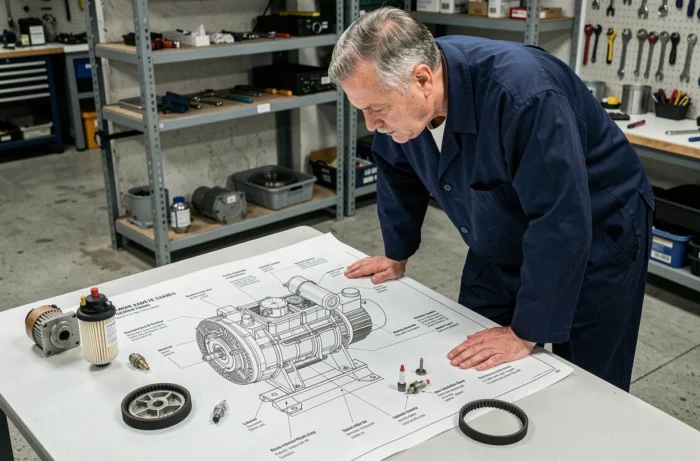
A SDMO generator consists of several dozen parts assembled around two main blocks: the thermal engine and the alternator. When a breakdown occurs or preventive maintenance is required, identifying the exact component to replace or check becomes a real challenge. The exploded view, this technical diagram that breaks down each sub-assembly into numbered spare parts, remains the reference tool to achieve this.
Nomenclature and identification of sub-assemblies on an SDMO diagram
The exploded view is not just a simple drawing. It associates each part with a reference number, which is linked to a nomenclature that specifies the manufacturer reference, the designation, and sometimes the original mounted quantity. On SDMO generators (now under the Kohler brand), this nomenclature follows the logic of the user and maintenance manual provided with each model.
The diagram is read starting from the largest sub-assemblies down to the details. Generally, one distinguishes the engine block, the cooling circuit, the fuel supply circuit, the exhaust system, the alternator, the chassis-cover, and the control panel. Each area has its own exploded view.
Consulting the exploded view of the SDMO generator allows cross-referencing part references with the maintenance operations described in the manual. Without this cross-referencing, ordering a filter or a gasket amounts to navigating blindly among references that vary from one engine type to another.
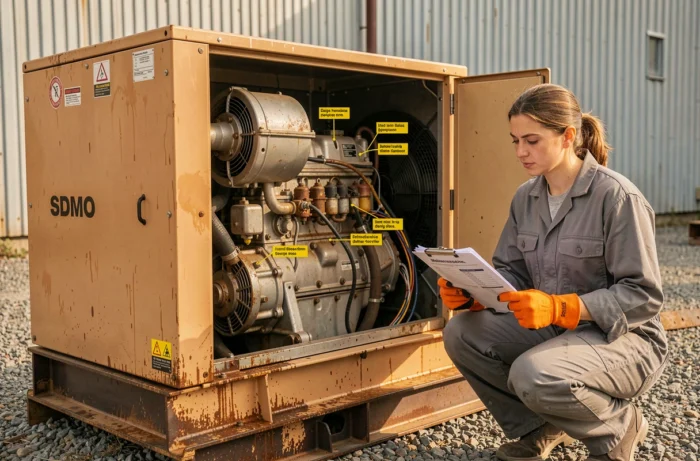
Oil circuit and air filter: two critical areas on the exploded view
Existing content on the maintenance of SDMO generators often addresses oil changes and air filter replacements as simple tasks. They are, provided you know which component to disassemble and in what order. This is precisely what the exploded view reveals.
Lubrication circuit
On the engine block diagram, the oil circuit appears as a set of internal pipes, a screwed oil filter, and a drain plug. The oil filter is not universal from one SDMO model to another. The reference changes depending on the engine displacement and type (Kohler, Mitsubishi, John Deere depending on the series). The identification on the exploded view avoids any confusion.
The drain plug, often represented at the bottom of the sump, has a reference number distinct from that of the fill plug. Confusing them may seem unlikely in the field, but on a covered generator where access is through a side hatch, the exploded view clarifies the exact position.
Air filter and intake housing
The air filter appears on a separate diagram associated with the intake circuit. On construction SDMO generators, the filter housing sometimes includes a cyclonic pre-filter. The exploded view then distinguishes three elements:
- The body of the housing, fixed to the block by silent blocks or specific screws whose tightening torque is indicated in the manual
- The main filtering element, referenced by a code specific to the engine type and not to the generator model
- The pre-filter (when it exists), which is cleaned separately and is not replaced at the same interval as the main element
Confusing the pre-filter and the main filter leads to premature engine fouling. The exploded view removes the ambiguity by representing them on two distinct levels of the diagram.
Control panel and electrical components on the exploded views
The electrical part of an SDMO generator is often the least documented in public maintenance guides. However, the SDMO user manuals (like that of the R44, available online) dedicate several pages to screen codes, control buttons, and wiring diagrams.
On the exploded view of the control panel, we find the control box, protection relays, output circuit breaker, and wiring connectors. Each connector carries a reference that corresponds to a single-line diagram in the manual. This link between the mechanical exploded view and the electrical diagram is often overlooked.
The revision of the NF C 15-100 standard published in August 2024, now structured into a series of twenty-one thematic texts, reinforces documentation requirements around installations integrating a generator. The selectivity of protections, the separation of normal and backup circuits, the maintainability of panels: all these points require precise knowledge of the internal diagram of the generator. The exploded view becomes an operational document, not just a tool for ordering parts.
Limitations of the SDMO exploded view and necessary supplements
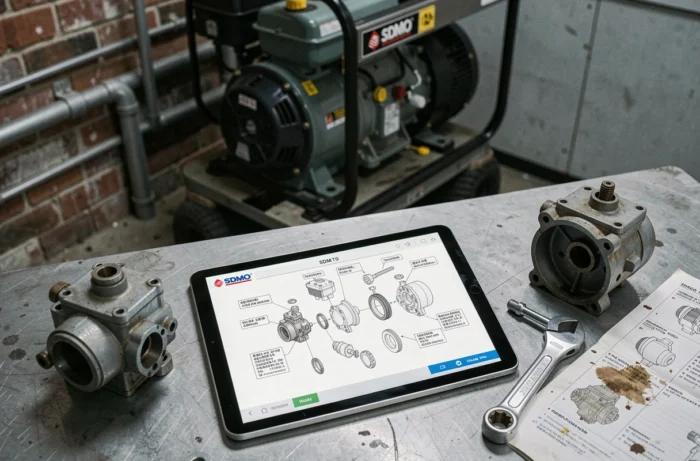
The exploded view does not cover everything. It represents the parts in their assembly position but does not provide information on tightening torques, removal-replacement procedures, or replacement intervals. This information is found in other sections of the user and maintenance manual.
Field feedback diverges on one point: the correspondence between original SDMO references and current Kohler references. Since Kohler acquired SDMO, some parts have changed coding without technical modification. Others have been replaced by Kohler equivalents with slightly different dimensions. Checking compatibility part by part remains necessary for generators over ten years old.
Some useful supplements to cross-reference with the exploded view:
- The maintenance log of the generator, which records operating hours and past interventions
- The single-line diagram of the installation, to understand how the generator integrates into the site’s electrical network
- The safety data sheets for fluids (oil, coolant), whose specifications vary according to the engine type
- Kohler technical bulletins, which indicate changes in references and potential recalls
A well-maintained generator relies on complete documentation. The exploded view is its backbone, but it only works when associated with the manual and the maintenance history. Storing these documents together, near the generator or in a maintenance management system, remains the most reliable method to avoid ordering errors and approximate interventions.


