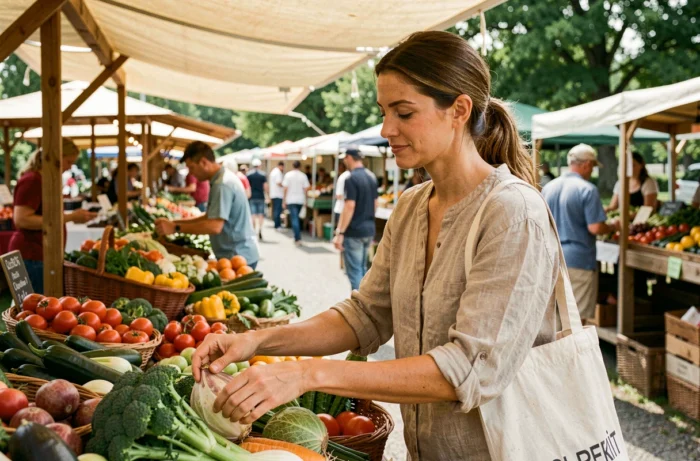
Measuring the real impact of daily habits on the environment and health remains a delicate exercise. Between the resurgence of the organic market, the evolution of sobriety behaviors, and new expectations from companies, recent data paints a more nuanced picture than a simple list of green actions. This article compares the levers of a healthy and eco-responsible lifestyle in light of trends observed in France.
Sobriety and sustainable consumption: what recent data shows
The Sobriety Barometer ADEME/L’ObSoCo (summer 2025 survey) reveals a paradox. A large majority of French people declare they want to keep their products for as long as possible and limit unnecessary purchases. The environmental motivation is slightly declining in favor of a stronger expectation from companies.
This shift changes the framework of understanding. Sobriety remains socially acceptable, but demand is shifting towards an offer of durable and repairable products rather than just individual effort. In other words, consumers want to buy better, not just buy less.
| Lever | Trend 2023-2025 | Dominant expectation |
|---|---|---|
| Sobriety (reducing purchases) | Stable adherence, ecological motivation slightly declining | Transfer of responsibility to brands |
| Organic products | Market recovery in value and volume (2025) | Accessible organic, short supply chains |
| Repair and second-hand | Continuous growth | Products designed to last |
| Recycled packaging | Industrial initiatives (e.g., Volvic, 100% recycled plastic) | Generalization across all sectors |
This table highlights a shift: the eco-responsible lifestyle is no longer limited to isolated individual actions. It relies on an ecosystem where supply, regulation, and personal choices interact. Platforms like veralifestyle.com precisely gather inspirations that intersect health, well-being, and ecological commitment in daily life.

Organic products and sustainable food: market recovery in France
After several years of decline, the consumption of organic products is increasing again in 2025 according to the Agency Bio. The share of organic in the average shopping basket is progressing in value and volume compared to 2024.
This recovery does not mean a return to the pre-crisis model. Consumers now favor short supply chains and specialized stores. Supermarket organic, perceived as less coherent, is losing ground to local producers.
Local food and health: a direct link
Choosing seasonal products grown locally reduces the transport footprint and promotes a diet richer in nutrients. A vegetable picked at maturity, sold in the following days, retains more vitamins than an imported product stored for several weeks.
- Seasonal fruits and vegetables bought through short supply chains: less packaging, less transport, more freshness.
- Bulk products (grains, legumes, spices): significant reduction in packaging waste on a daily basis.
- Aromatic herbs grown on a balcony or windowsill: partial autonomy, zero waste, almost no cost.
Sustainable eating does not require a complete upheaval of habits overnight. Replacing a few processed products with organic and local alternatives constitutes a measurable first lever.
Eco-friendly home: choices that truly impact the footprint
Competitors often detail lists of household actions (white vinegar, baking soda, air-purifying plants). These tips remain valid, but they obscure a heavier issue: the energy efficiency of the home represents the primary environmental impact factor of a household.
Insulation, the choice of heating system (wood, heat pump), and hot water management weigh much more than the type of household product used. An interior decorated with natural materials (wood, linen, hemp) also contributes to a healthier indoor environment by limiting volatile organic compounds emitted by conventional furniture and paints.
Zero waste and circular economy at home
The zero waste approach is becoming more practical. Alternatives to disposable products have multiplied: bee wraps, water bottles, reusable containers, balcony composters. However, the effectiveness of these actions depends on their regularity.
A home composter diverts a significant portion of organic waste from the regular trash. Combined with selective sorting and bulk purchasing, it significantly reduces the volume of household waste produced each week.

Sustainable fashion and natural cosmetics: beyond greenwashing
The fashion and cosmetics sector concentrates a significant share of the prevailing greenwashing. Distinguishing a truly eco-responsible product from a simply rebranded one requires checking a few concrete criteria.
- Recognized labels (GOTS for textiles, Cosmos Organic for cosmetics): they impose verifiable specifications.
- Short and readable composition: less than ten ingredients for a natural cosmetic is a good indicator of simplicity.
- Product durability: a garment made from natural fibers (linen, organic cotton) designed to last several seasons costs more at purchase but is cheaper per use.
- Second-hand and repair: resale or alteration extends the lifespan of a garment and reduces the demand for new production.
The growth of second-hand confirms a data point from the ADEME barometer: the French expect concrete alternatives, not just injunctions. Sustainable fashion works when it offers desirable, accessible products designed to last.
Adopting a healthy and eco-responsible lifestyle is measured less by the number of checked actions than by the coherence between diet, habitat, consumption, and product choices. The 2025 data shows that demand is shifting towards structural solutions, driven as much by individuals as by the sectors that supply them.


