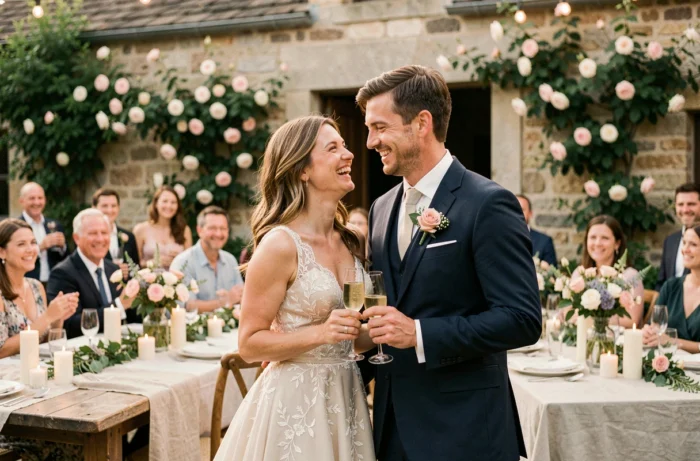
Organizing a personalized wedding today involves navigating between aesthetic desires, concrete logistical constraints, and a growing awareness of the environmental impact of the reception. Couples planning their ceremony in 2026 face a trade-off that traditional inspiration guides often overlook: how to make a day unique without sacrificing guest comfort or increasing the ecological footprint of the event.
Wedding Personalization vs. Guest Comfort: The Real Trade-Off
The personalization of a wedding quickly encounters a practical limit: what pleases the couple does not always align with the experiences of the guests. An outdoor ceremony in a remote location creates a unique atmosphere, but it complicates access, parking, and sometimes accommodation for some attendees.
The same discrepancy arises with extended formats. Multi-day celebrations are gaining traction, with wedding weekends including brunch, activities, and an evening event. This format allows for more shared moments, but it increases costs for guests (transportation, accommodation, availability) and can lead to fatigue or even cancellations.
Before choosing a venue or format, it is useful to cross-reference two grids: that of the experience desired by the couple and that of the actual constraints of the guest group (average distance, presence of children, reduced mobility). Vendors specializing in wedding planning often provide tools to facilitate this trade-off. You can discover the MB Mariage website to explore options that integrate this logic from the project’s conception.
Environmental Impact of a Wedding Reception: Beyond the Symbolic Gesture
Sustainability is no longer presented as a mere decorative addition in recent weddings. It is establishing itself as an organizational principle, with choices affecting both logistics and aesthetics.
Flowers, Decoration, and Food Waste
The use of local and seasonal flowers is gradually replacing imported arrangements. This choice reduces the carbon footprint of the floral component, but it also imposes a constraint on the color palette and available varieties depending on the wedding date.
In terms of decoration, the trend is towards renting or reusing items rather than purchasing disposable pieces. Field reports vary on this point: some couples easily find networks for borrowing between individuals, while others struggle to create a coherent set without resorting to a dedicated vendor.
Reducing food waste is a concrete lever. Several approaches coexist:
- A menu with an adjusted number, confirming the exact number of guests late rather than a systematic surplus margin
- Service formats that limit leftovers (measured buffet, calibrated individual plates, elimination of the rarely finished intermediate dish)
- A partnership with a local organization to redistribute food surplus after the reception
An eco-responsible wedding is about logistics, not just appearances. Slapping a “green” label on an invitation printed on seeded paper does not compensate for a venue that requires most guests to fly.
Phone-Free Ceremony: What an Unplugged Wedding Changes
The unplugged wedding, where guests are asked to put away their phones during the ceremony, is becoming an increasingly common practice. The principle is simple: guests remain present rather than continuously photographing.
The idea sounds appealing on paper. It allows the professional photographer to work without arms stretched into the frame, and it changes the atmosphere of the ceremony by refocusing attention on the moment being experienced.
In practice, implementation requires a minimum of communication in advance. A sign at the entrance to the ceremony venue is not always sufficient. Couples who achieve the best results combine a mention on the invitation, a reminder from the officiant, and a dedicated space after the ceremony for guests to take group photos.
The available data does not allow for measuring the actual impact on guest satisfaction. Some appreciate the disconnection, while others perceive the request as a restriction, especially close friends and family who cannot attend the entire day and wish to keep their own memories.

Wedding Budget: Areas Where Personalization Really Costs More
Personalization comes at a price, but it is not evenly distributed. Some areas absorb most of the additional costs, while others offer real flexibility.
The reception venue remains the most structuring item in the budget. An atypical space (vineyard, renovated farm, urban rooftop) generally costs more than a traditional hall, and often requires hiring external vendors for catering, sound, or coordination.
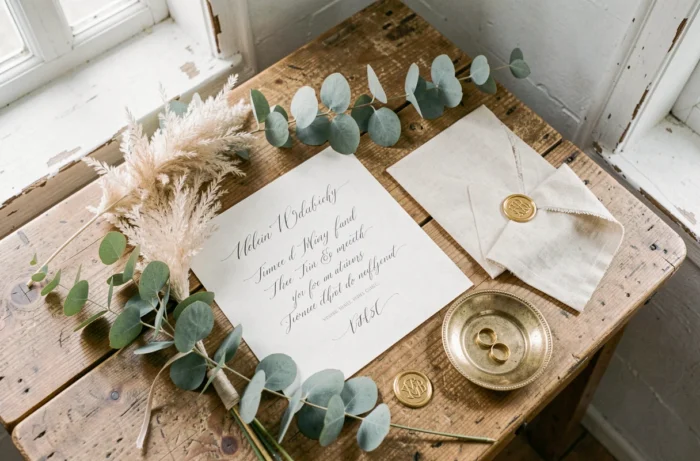
Custom stationery (illustrated invitations, calligraphed menus, personalized seating plans) represents an item whose unit cost remains moderate, but whose total can quickly rise with the number of guests. In contrast, reusable or rented decorative elements can help absorb part of the additional cost.
Items where personalization costs almost nothing deserve to be identified:
- The music playlist, created by the couple rather than fully delegated to a DJ
- The texts for the civil ceremony, written by loved ones
- The choice of an unconventional meal format (brunch, food trucks, potluck) that can reduce the catering bill while creating a distinct atmosphere
A realistic wedding budget incorporates the additional costs of personalization from the venue selection phase, not afterward. Late adjustments to decoration or entertainment never compensate for a venue that is oversized relative to available resources.
The most successful personalized wedding is not the one that accumulates original touches, but the one where every logistical, aesthetic, and budgetary choice has been weighed according to what truly matters to the couple and the people present that day.


