
A helicoidal mower cuts grass by shearing between a spiral blade cylinder and a fixed counter-blade. This mechanical principle, distinct from the rotary blade that strikes and tears the blades, produces a clean cut comparable to that of a pair of scissors. Understanding this mechanism allows for better model selection and maintenance adaptation for this type of machine.
Battery-powered helicoidal mower: the game-changing segment
Most guides focus on manual or thermal models. The new generation of battery-powered helicoidal mowers has been redefining usage for several seasons. These models combine the shearing cutting principle with the flexibility of an electric motor powered by a removable lithium-ion pack.
The main advantage lies in user comfort. A model like the Webb RB4 offers about an hour of autonomy and an adjustable cutting range between 13 and 23 mm, extendable to 40 mm with accessories. For a small residential garden, this autonomy easily covers a complete mowing session.
However, switching to battery introduces a constraint that manual versions ignore: loss of torque on dense grass. When the grass is tall or wet, the cylinder turns more slowly, and the quality of the cut deteriorates. The solution is simple: mow more often, at a moderate height, to stay within the optimal performance zone of the motor. Understanding the operation of a helicoidal mower helps anticipate this limit and adjust mowing frequency accordingly.
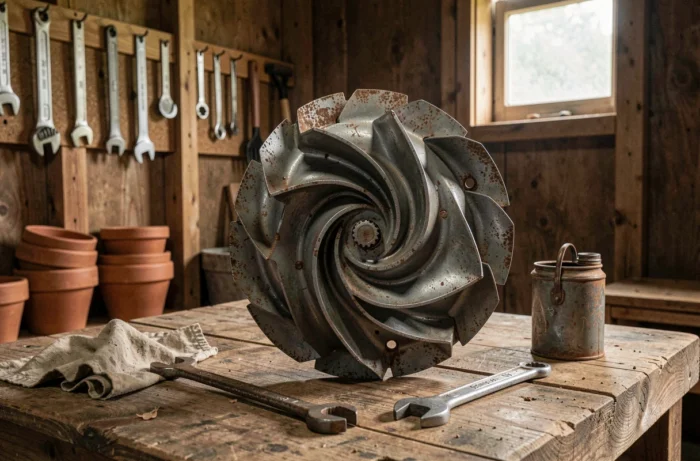
Cylinder and counter-blade: the cutting mechanism in detail
The heart of a helicoidal mower is its cutting cylinder, a horizontal axis on which several blades are fixed in a spiral arrangement. When the cylinder turns, each blade passes as close as possible to a fixed counter-blade located at the bottom of the housing. The grass blade, caught between the two surfaces, is cut cleanly.
Two parameters directly influence the quality of the result:
- The number of blades on the cylinder (often between five and ten depending on the models) determines the fineness of the cut. The higher the number, the closer and more even the mowing, which explains why golf greens use cylinders with numerous blades.
- The gap between the cylinder and the counter-blade must remain minimal. A gap that is too large allows the blades to bend instead of being cut, resulting in a yellowed appearance within a few days.
- The rotation speed of the cylinder relative to the forward speed defines the number of cuts per meter. A high ratio provides a more uniform finish, sometimes visible as alternating stripes on the lawn.
Some models incorporate flexible-toothed combs upstream of the cylinder. These combs straighten the bent blades before they reach the cutting zone, ensuring an even cut even on slightly wet grass.
The scissor effect compared to the rotary blade
A rotary blade spins at high speed on a horizontal plane and cuts by impact. The blade is cut but often shredded at the tip. A helicoidal mower, by shearing, produces a clean section. The difference is visible to the naked eye: grass mowed with a helicoidal mower remains green at the tips, while grass mowed with a rotary mower may slightly yellow at the ends.
A clean cut reduces the injury surface on each blade, limiting the entry of pathogens and promoting denser regrowth.
Maintenance of helicoidal blades: sharpening and adjustment
The maintenance of a helicoidal mower boils down to two technical actions: sharpening the cylinder and adjusting the gap with the counter-blade. Neglecting either transforms a precision tool into a machine that crushes grass instead of cutting it.
When and how to sharpen the cylinder
Sharpening is done by backlapping, a technique that involves rotating the cylinder in reverse against the counter-blade, with an abrasive paste applied to the cutting edges. This operation realigns the two cutting surfaces without removing excessive material.
The frequency depends on usage. For a residential garden mowed once a week, backlapping at the beginning and end of the season is sufficient. On a sports field mowed daily, the operation may be necessary every few weeks.
The most reliable test to judge the condition of the blades: slide a sheet of newspaper between the cylinder and the counter-blade, then manually rotate the cylinder. If the sheet is cut cleanly across its entire width, sharpening is correct. If it tears or bends, backlapping is required.

Adjustment of the cylinder-counter-blade gap
The gap is adjusted via side screws on most models. The goal is to bring the cylinder close to the counter-blade until a slight uniform metallic friction is heard during manual rotation, without hard spots or blockage.
An overly tight adjustment prematurely wears the blades and requires more energy from the motor (or the arms, on a manual model). An overly loose adjustment allows fine blades to pass without being cut.
Suitable grass and mowing surface: the limits to know
The helicoidal mower excels on short, regularly mowed grass and on relatively flat terrain. Manual models are suitable for modest surfaces, while motorized versions (thermal or battery-powered) cover larger areas.
Several constraints deserve to be clearly stated:
- Grass left too high between mowings exceeds the cutting capacity of the cylinder, which can only absorb a certain thickness of vegetation with each pass.
- Bumpy or stony terrains, or those scattered with branches or roots, expose the cylinder to shocks that distort the parallelism with the counter-blade.
- Grasses with thick stems (tall fescues, certain ryegrasses) resist shearing more than fine grass types like agrostis or creeping fescue.
Garden maintenance around mowing also matters: a lawn mowed at the right frequency with a helicoidal mower develops denser foliage that is more resistant to diseases, reducing the need for phytosanitary products.
The choice between a helicoidal mower and a rotary model is not just about cut quality. Mowing regularity, terrain nature, and the type of grass installed condition the final result. A well-sharpened cylinder on suitable grass produces a finish that the rotary blade cannot replicate, but this performance comes at a price: a stricter mowing discipline and regular mechanical maintenance.