In Brussels, the regulatory framework surrounding boiler maintenance has significantly evolved in recent years. The order from the Government of the Brussels-Capital Region dated June 6, 2024, has expanded and strengthened the PEB obligations: all gas boilers, including small domestic units, are now subject to a PEB periodic inspection every two years.
Before 2019, only boilers over 20 kW were affected, and the frequency for gas was three years. This regulatory acceleration changes the game for both occupants and owners.
PEB Inspection and Technician Accreditation: What Brussels Regulations Really Require
The PEB inspection is not just a comfort maintenance check. It is a standardized inspection that verifies combustion efficiency, flue gas tightness, and pollutant emissions. Only a technician accredited by Brussels Environment can issue the PEB inspection certificate, a document that is enforceable in case of disputes or incidents.
The distinction between a “regular” heating technician and an accredited technician lies in this regional accreditation. A non-accredited professional can technically clean a burner, but the certificate they would produce would have no legal value. For oil boilers, maintenance remains annual. For gas, the shift to two years may seem more flexible, but non-compliance exposes one to administrative penalties and, above all, to a refusal of compensation by the insurer in case of an incident.
Among the services offered by Reflexe Habitat in Brussels, the intervention covers this certification aspect, which avoids separating mechanical maintenance from regulatory control.

Ban on New Gas and Oil Boilers: An Existing Stock Under Pressure
Since January 1, 2025, new homes (or equivalent) for which a building permit is submitted in Brussels can no longer be equipped with gas boilers. Heat generators must operate on electricity, renewable energies, or be connected to an efficient thermal network. Since June 1, 2025, the installation of new oil boilers is also prohibited.
This double ban does not apply to boilers already in place. However, it produces an indirect effect: the existing stock of gas and oil boilers in Brussels will age without being replaced like for like. Therefore, the appliances in service will need to last longer, making regular maintenance even more crucial to maintain their efficiency and safety.
A Changing Pool of Technicians
Accredited heating technicians must now master both the maintenance of traditional boilers and the installation of heat pumps or hybrid systems. Field reports vary regarding the actual availability of qualified technicians for both types of interventions. In this transition context, ensuring that the chosen professional has a valid Brussels PEB accreditation remains the most reliable precaution.
Combustion Efficiency and Safety: What Maintenance Allows to Measure
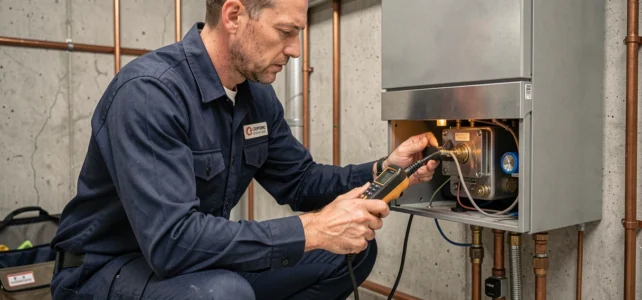
Maintenance performed by an accredited technician is not limited to cleaning the burner and the heat exchanger. Combustion analysis is the central technical aspect. It quantifies the actual efficiency of the appliance and detects any abnormal production of carbon monoxide.
According to data from ENGIE Belgium, regular maintenance can reduce energy consumption by around 10% and decrease the carbon footprint by approximately 350 kg of CO2 per year. These figures correspond to a boiler that is properly adjusted after maintenance, compared to a unit whose combustion parameters have drifted.
Specifically, during a complete maintenance check, the accredited technician performs several verifications:
- Cleaning the burner, heat exchanger, and flue gas outlet to remove deposits that reduce heat transfer.
- Measuring combustion efficiency and CO and CO2 levels in the flue gases, comparing them to Brussels regulatory thresholds.
- Checking the water circuit pressure, the tightness of connections, and the proper functioning of safety devices (thermocouple, pressure switch, valve).
- Issuing the maintenance certificate and, if applicable, the valid two-year PEB inspection certificate for gas.
Cost of Boiler Maintenance in Brussels: Order of Magnitude and Variables
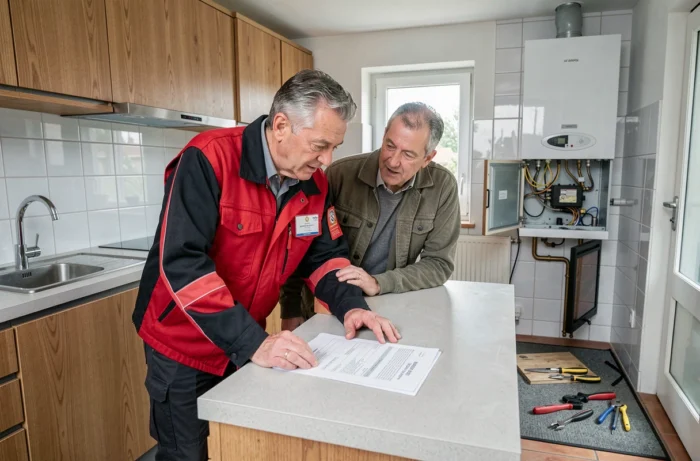
Prices vary depending on the type of fuel and the service provider. Data published by ENGIE for Belgium provide a benchmark: starting from 203 euros for a gas boiler and starting from 250 euros for an oil boiler, VAT at 6% included. The VAT rate rises to 21% for homes ten years old or less.
These amounts cover travel, maintenance, VAT, and the issuance of the certificate. An annual maintenance contract with smooth monthly payments can reduce the perceived cost but commits one over time. The available data do not allow for fine comparisons of prices among all service providers active in Brussels, as quotes depend on the power of the appliance, its accessibility, and its age.
Tenant or Owner: Who Pays in Brussels
The distribution depends on the lease. Generally, routine maintenance is the tenant’s responsibility, while the replacement of the boiler or structural repairs fall to the owner. Disputes arise when the lease does not explicitly specify this distribution. Checking the maintenance clause before signing avoids later disagreements.
The Brussels framework surrounding boiler maintenance combines strengthened PEB obligations, a gradual ban on new fossil installations, and accreditation requirements for technicians. For a gas or oil appliance still in service, using an accredited technician is not an optional precaution: it is the condition for obtaining a valid certificate, maintaining the efficiency of the installation, and remaining covered in case of an incident.