
You order a cap online, it arrives, you put it on your head: too tight at the forehead, or it floats and slips as soon as you turn your head. The problem rarely comes from the model. It almost always stems from a poorly taken measurement or a misunderstanding of the sizing system.
Measuring head circumference for a cap: the technique that changes everything
Most guides recommend placing a tape measure above the ears and eyebrows. This is correct, but incomplete. What makes the difference is the tension applied to the tape and the exact spot where it is positioned at the back of the head.
Place the tape about one centimeter above the tops of the ears, passing through the most prominent point at the back of the head (the occiput). The tape must be flat and horizontal all around, without dipping into the nape or rising towards the top of the skull. The right tension: the tape touches the skin everywhere, without compressing.
A common trap is measuring too high, towards the middle of the skull. This results in an underestimated head circumference, and the received cap feels tight at the forehead. Conversely, measuring too low, down towards the nape, artificially inflates the value.
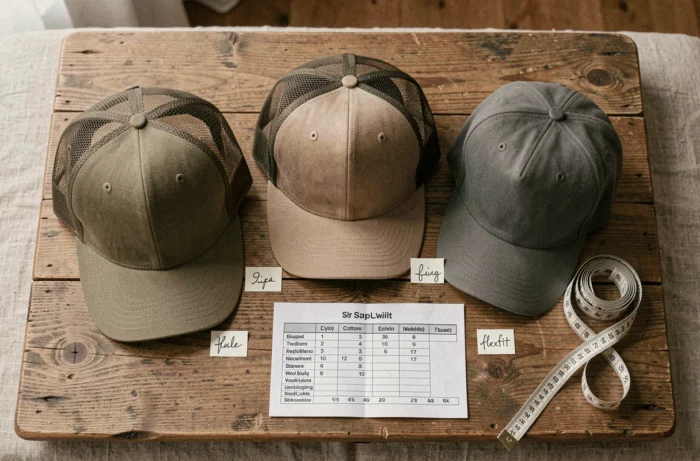
If you don’t have a flexible tape measure, a string and a ruler will do. Wrap the string around, mark the crossing point, then measure the length obtained flat. For those who hesitate about the method, the guide to choosing the right cap size details each step precisely.

Cap size and head circumference correspondence: reading labels without mistakes
Once the measurement in centimeters is obtained, it needs to be converted. And this is where things get complicated, because size charts vary from brand to brand.
Classic size chart S, M, L, XL
The most common correspondence in France follows this breakdown:
| Size | Head Circumference |
|---|---|
| S | 54-55 cm |
| M | 56-57 cm |
| L | 58-59 cm |
| XL | 60-61 cm |
This table is a base, not an absolute rule. Some brands shift their ranges up or down by one centimeter. We’ve seen size M listed as 55-56 cm by one manufacturer and 57-58 cm by another.
Double sizes and hybrid systems
For a few seasons now, several streetwear and sportswear brands have offered pre-calibrated ranges combined with an adjustment: S/M (covering approximately 54-58 cm), M/L (57-61 cm), L/XL (61-65 cm). Each range then has a strap for fine-tuning. This hybrid system significantly reduces the risk of returns compared to the simple “one size fits all” adjustable.
When buying online, the only reliable precaution remains to consult the specific size guide of each brand, not a generic chart found elsewhere.
Adjustable cap or fixed size: which adjustment system to choose
The choice between adjustable and fixed does not depend solely on comfort. It depends on how the cap will be used and the accuracy of its measurement.
- Snapback: plastic snap closure at the back, adjustable in notches. Convenient for sharing a cap or when unsure about your size, but field returns show that the effective comfort range is often narrower than the range advertised by the manufacturer.
- Strapback: fabric, leather, or nylon strap with a buckle. The adjustment is finer than a snapback, without fixed notches. You can tighten it to the millimeter.
- Fitted (fixed size): no adjustment, the cap is sold in a specific size (often in inches or centimeters). The fit is superior, but the slightest measurement error can be costly. You need to be sure of your head circumference.
- Flexfit (elastic): integrated elastic band that conforms to the head. Comfortable from the first wear, but the elastic loses its tension over time, especially in heat.
For a first online purchase, a strapback system or a model with pre-calibrated ranges limits unpleasant surprises. The fixed size is reserved for those who already know their exact head circumference and the size chart of the targeted brand.
Face shape and cap style: the often overlooked angle
There is much talk about head circumference, but rarely about face shape. Yet, a well-tailored cap can look disproportionate if the visor or depth of the crown does not match the morphology.
A round face benefits from wearing a cap with a slightly curved visor and a structured crown, which visually elongates the features. An elongated face handles flat visors and low crowns (dad cap style) better, which break the verticality.
The depth of the crown matters as much as the head circumference. Two caps in size M can have the same circumference but very different crown heights. A deep crown suits round heads, while a low crown suits flat heads.
Returns vary on this point because the perception of comfort also depends on hairstyle. Thick or voluminous hair adds bulk under the crown, which may require going up half a size from the bare measurement.
What to do when you fall between two cap sizes
This is the most common situation: the tape measure reads 57.5 cm, right between M and L. The answer depends on the type of cap.
For a fixed size cap (fitted), you generally prefer the larger size. A slightly loose cap can be adjusted with a sweatband or a self-adhesive size reducer, sold in haberdasheries. A cap that is too tight, on the other hand, hardly stretches at all, even after weeks of wear.
For an adjustable cap, it’s the opposite. You choose the lower range if you are at the top of your range, to keep some margin for tightening. A snapback adjusted to the last notch loses all interest in adjustment.
The material also plays a role. Woven cotton stretches slightly after a few uses. Polyester and nylon retain their original shape. A wool cap may shrink if exposed to moisture without proper drying.
Before finalizing an order, check three elements: the measurement taken correctly flat, the specific size guide of the brand, and the type of back closure. These three points eliminate the vast majority of sizing errors.


