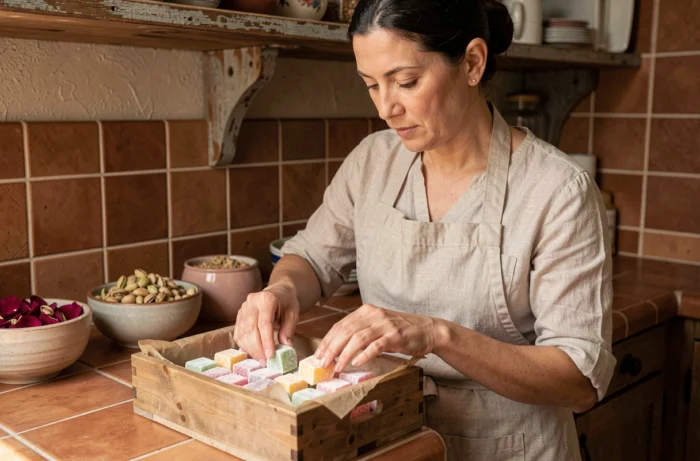
A piece of Turkish delight taken out of its box three days ago that sticks to your fingers, has lost its powdered sugar coating, and whose texture resembles a piece of gum left in the sun: you have already experienced this disappointment. The preservation of Turkish delights follows simple but very precise rules. The type of recipe, the ingredients, and the packaging make all the difference. Here’s how to keep your Turkish sweets soft and fragrant for as long as possible.
Why not all Turkish delights are preserved the same way
A plain rose Turkish delight, made from sugar, starch, and cornstarch, does not react the same way as a Turkish delight filled with pistachios, nuts, or coated in chocolate. The fats from dried fruits can go rancid. Chocolate can bloom in heat. Moist fillings (cream, jam) accelerate microbial development.
Therefore, the shelf life varies greatly depending on the recipe, production technique, and type of packaging. Applying the same timeframe to all Turkish delights is a common mistake. The only reliable reference remains the manufacturer’s indication on the package. A classic rose Turkish delight lasts much longer than one enriched with dairy products or fresh fruits.
Before applying the following tips, identify the category of Turkish delight you have. This is the first step, and most preservation guides skip it. For everything you need to know about preserving Turkish delights according to their composition, this distinction between classic recipes and enriched recipes makes all the difference.
Preserving Turkish delights at room temperature: conditions and pitfalls
Room temperature is suitable for classic Turkish delights (sugar, starch, rose water, cornstarch) provided that a few principles are respected.
Mastering humidity and light
Humidity is the primary enemy of Turkish delight. It melts the powdered sugar or cornstarch coating, makes the surface sticky, and promotes mold. Store your Turkish delights in a dry place, away from direct light. A closed kitchen cupboard, far from the oven and stovetop, works well.
Light also degrades aromas, particularly rose water and orange blossom. A Turkish delight exposed on a decorative platter loses its flavors in a few days, even if it remains edible.
Choosing the right container
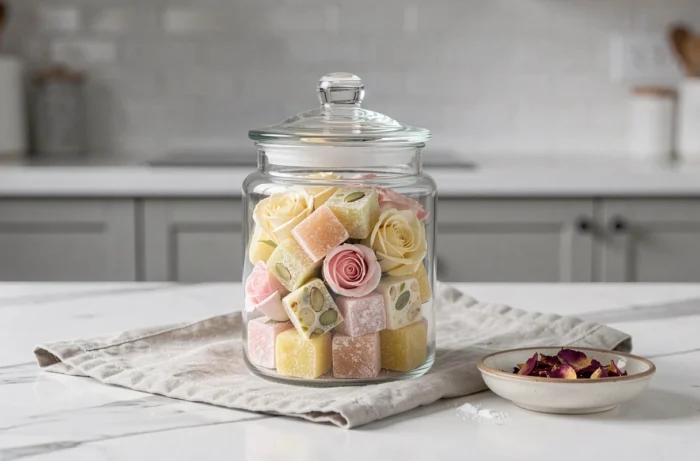
A metal box or an airtight glass container protects better than a plastic bag closed by hand. Separate each layer of Turkish delights with parchment paper to prevent them from sticking together. Parchment paper absorbs excess surface moisture without drying out the candy.
- Place a sheet of parchment paper at the bottom of the container, then between each layer of Turkish delights.
- Do not mix different flavors in the same box: rose will contaminate pistachio, and vice versa.
- Close the lid immediately after each serving to limit contact with ambient air.
- Avoid direct contact with plastic wrap, which traps condensation and makes the surface sticky.
Should you refrigerate Turkish delights?
You may have read conflicting advice on this point. The answer depends on the type of Turkish delight.
For a classic Turkish delight (sugar, starch, flavor), the refrigerator is rarely necessary and often counterproductive. Cold hardens the dough, alters the melting texture, and causes condensation upon removal. You end up with a firm Turkish delight, moist on the surface, that has lost its characteristic softness.
For an enriched Turkish delight (filled with fresh nuts, cream, fruits), the refrigerator becomes useful if the temperature in your kitchen regularly exceeds comfortable thresholds. In this case, wrap them in an airtight container to isolate them from fridge odors. Take them out about twenty minutes before tasting to allow them to regain their flexibility.
Artisanal Turkish delights and modified atmosphere packaging
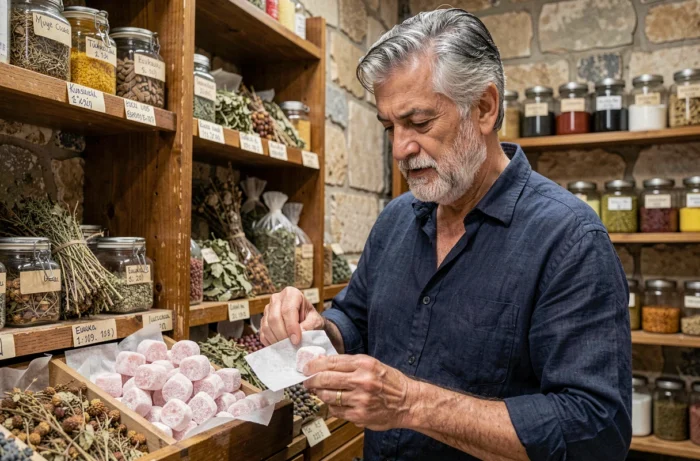
The market for high-end Turkish delights is evolving. Packaging suppliers in Turkey now offer boxes in a protective atmosphere, using a mixture of nitrogen and CO₂. This technique, already common for other food products, aims to extend shelf life without altering texture or taste.
If you buy Turkish delights in a gift box or during a trip, check if the packaging mentions this type of conditioning. Once the box is opened, the protection disappears: the classic preservation advice immediately applies. Transfer the contents to an airtight container as soon as it is first opened.
For homemade Turkish delights, this technology is not accessible. Proper cooking of the sugar-starch mixture remains the best guarantee of longevity. Insufficient cooking produces a Turkish delight that is too soft and degrades quickly. Excessive cooking results in a dry and brittle dough.
Signs that your Turkish delights are no longer good
Even when well preserved, Turkish delights do not last indefinitely. A few signs can help identify candy that has gone bad.
- The surface has become liquid or shows mold spots: throw it away without hesitation.
- The smell has changed, with a sour or fermented note, especially in fruit varieties.
- The texture has become grainy or excessively hard, a sign of sugar recrystallization linked to prolonged storage or temperature fluctuations.
A Turkish delight that has simply lost its powdered sugar coating remains edible. You can roll it again in a mixture of powdered sugar and cornstarch to restore its original appearance. This gesture also extends protection against moisture.
Preserving Turkish delights ultimately relies on three principles: adapting the method to the recipe, isolating from humidity and light, and never ignoring the manufacturer’s indications. A well-stored Turkish delight keeps its Eastern flavors intact far beyond what one might imagine, provided that a pistachio Turkish delight is not treated like a rose Turkish delight.


