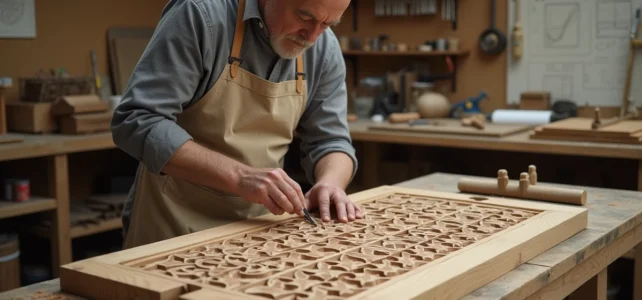
The moucharabieh is a perforated panel made up of small pieces of wood assembled without nails or screws, according to a repetitive geometric framework. Making this element yourself allows you to control the pattern, dimensions, and wood type used, while adapting the piece for a specific use: partition, radiator cover, or screen in front of a window.
Wood Expansion in Heated Interiors: The Parameter That Cutting Doesn’t Address
Most manufacturing tutorials focus on drawing the pattern and cutting. The problem arises after installation. A moucharabieh rigidly fixed in a frame, near a radiator or underfloor heating, undergoes cycles of expansion and contraction that eventually distort the crosspieces or open the joints.
Solid wood moves more in the direction perpendicular to the fibers. On a perforated panel where the pieces intersect, these movements accumulate. Allowing a gap of a few millimeters between the frame and the panel prevents the structure from warping or cracking at the joints.
Two practical precautions limit the risk. Store the wood in the destination room for several days before machining, so that its moisture content balances with the environment. Fix the panel to the frame using elongated screws or sliding brackets, rather than peripheral gluing, to allow the wood to breathe.
To learn everything about wooden moucharabieh and its technical constraints, these details make the difference between a durable panel and one that warps at the first winter.
Choosing the Wood Type and Finish for an Indoor Moucharabieh
The wood type determines both the ease of machining, the durability of fine joints, and the final appearance of the pattern. Not all wood types are suitable for work with perforated crosspieces.
Wood Types Suitable for Fine Geometric Patterns
Beech and oak offer a tight grain that holds up well under small sections without splitting. MDF (medium-density fiberboard) allows for very clean laser or router cutting, but lacks mechanical strength on narrow crosspieces. Birch plywood remains a solid compromise for large surface panels: its cross-laminated structure limits movement and facilitates cutting complex patterns with a scroll saw.
Pine, often chosen for its price, poses a problem with knots. A knot placed on a crosspiece just a few millimeters wide weakens the piece and creates a visual irregularity in the pattern.
Low VOC Finishes
Water-based finishes limit the emissions of volatile organic compounds in the indoor space. Acrylic varnishes and water-based hard oils, now widely available, offer protection comparable to traditional solvent-based products without degrading indoor air quality.
Applying the finish before the final assembly of the panel in its frame allows for treatment of each face and edge of the crosspieces, including areas that become inaccessible once the moucharabieh is assembled.
Assembly Method for a Non-Turned Wooden Moucharabieh
The traditional technique relies on hundreds of small turned pieces, fitted into a grid by friction. This approach requires a wood lathe and considerable patience. A more accessible method for a home project involves working by layering cut frames.
Principle of the Glued Double Frame
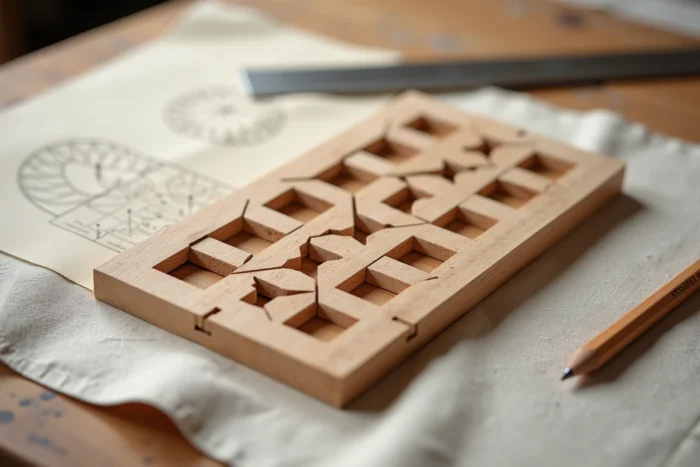
The panel consists of two layers of slats or perforated plates, offset from each other to create the intersection pattern. Each layer is cut separately (scroll saw, router with template, or laser cutting for the more equipped), then the two frames are glued face to face.
- Trace the pattern at a 1:1 scale on a rigid cardboard template before transferring it to the wood, to ensure that the proportions work visually at the actual reading distance
- Cut each frame leaving a peripheral excess, then flush with the frame after gluing, which guarantees a clean alignment of the edges
- Use a vinyl adhesive (white glue) applied in a thin and uniform film, with clamping or weighted pressing during drying
- Sand both faces of the assembled panel with fine grit to remove glue drips and even out the surface before finishing
This double frame technique avoids turning while producing a relief and play of shadows comparable to traditional moucharabieh. The total thickness of the panel depends on the thickness of each layer: two frames of a few millimeters are sufficient for a lightweight partition, while a furniture or door covering can accommodate thinner sections.
Installation and Integration of the Moucharabieh as a Space Divider
The method of fixation influences the visual effect as much as the sturdiness. A moucharabieh applied against a wall does not serve the same function as a panel suspended between two posts to delineate an open space.
- In a freestanding partition, the panel fits into a solid wood frame fixed to the floor and ceiling by brackets, with a gap at the top to absorb the building’s movements
- As a radiator cover, the frame is mounted on legs or suspended from wall battens, leaving sufficient space between the panel and the radiator to avoid blocking convection
- As a sliding door, the panel is mounted on an exposed rail, allowing for opening or closing the separation as needed, while maintaining light filtered through the perforated patterns
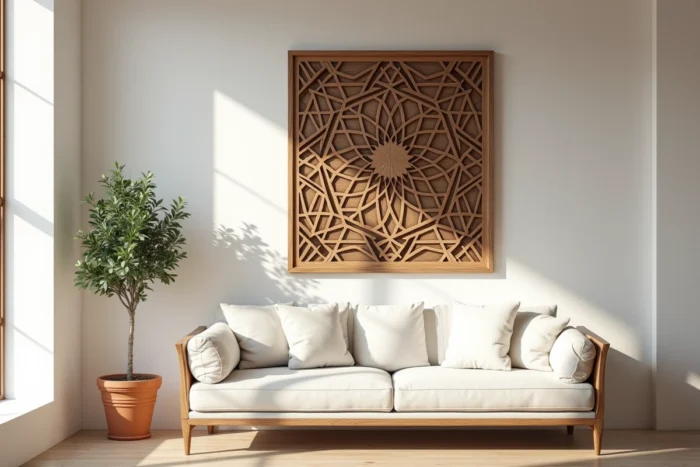
The spacing between the moucharabieh and the light source radically changes the projected shadow. The further the panel is from the window or light fixture, the more softly the patterns diffuse onto the opposite wall. Conversely, a panel pressed against the source produces sharp and contrasting shadows.
The choice of pattern, wood type, and installation method forms a coherent whole. A birch plywood panel, assembled with a double frame, mounted on a sliding rail, and finished with water-based hard oil serves as a partition, light filter, and decoration, without compromising the air quality of the room.