
A crumbling or cracked threshold is not just an aesthetic issue. It is a breach in the waterproofing of the entrance, a low point where water stagnates, freezes, and eventually corrodes the reinforcements embedded in the concrete. Here, we approach the repair from a technical perspective that distinguishes between cosmetic resurfacing and a lasting solution.
Waterproofing the threshold: the real problem behind the cracks
A cracked threshold functions like an inverted drain. Instead of directing runoff water outside, it retains it in its crevices. The freeze-thaw cycle widens the cracks over several seasons, and moisture reaches the rebar. The resulting oxidation causes the steel to swell, accelerating the spalling of the surrounding concrete.
This mechanism has direct consequences on the energy performance of the entrance. A degraded threshold creates a thermal bridge at ground level, exacerbated by air infiltration if the sliding or swinging gate no longer rests on a flat base. The coordination between threshold height, thermal and acoustic constraints is a point we recommend validating with a professional, especially during renovations.
Before knowing how to fix a threshold, it is essential to diagnose the cause of the degradation: slope defects, lack of drainage shape, or underdosed concrete from the outset. Without addressing the cause, any repair will be temporary.
Site diagnosis before repairing the concrete threshold
We observe three levels of degradation that dictate the repair method.
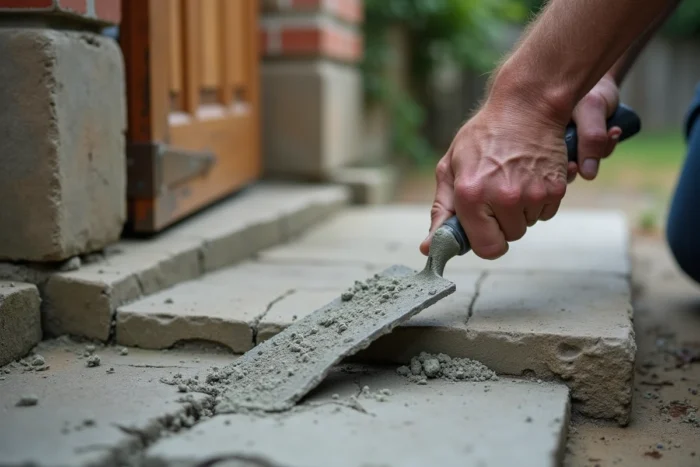
- Superficial wear (less than one centimeter deep): surface crazing, loss of laitance. The underlying concrete remains sound, and the reinforcement is not exposed. A fiber-reinforced resurfacing is sufficient.
- Through cracks with initial spalling: water has penetrated to the rebar. The area must be purged, the reinforcement treated, and the surrounding concrete rebuilt before any resurfacing.
- Partial collapse or elevation difference greater than a few centimeters: the threshold has lost its load-bearing function. Only partial demolition followed by recasting with new reinforcement guarantees durability.
To assess the depth of the damage, a simple hammer sounding reveals hollow-sounding areas. Parts that produce a dull sound should be purged without hesitation.
Threshold repair with drainage and slope management
The point that most tutorials overlook is the shape of the slope. A properly reshaped threshold has a slight slope towards the outside, on the order of a few millimeters per linear meter, sufficient to ensure that water never stagnates on the surface.
Preparation of the existing surface
Start by cutting the degraded concrete with a diamond blade across the entire width of the threshold. A clean cut prevents crack initiation around the repair perimeter. Remove all fragments until reaching sound concrete, then brush the exposed reinforcements with a wire brush.
If the rebar shows advanced corrosion (visible loss of section), we recommend adding treated steel reinforcement pins, tied to the existing rebar with ties. A minimum coverage of the reinforcement with new concrete is crucial for the longevity of the repair.
Choosing the right repair mortar for the exterior threshold
A standard indoor resurfacing mortar is not suitable. For a threshold exposed to the elements and rolling loads, the repair material must meet several requirements:
- High mechanical resistance, compatible with vehicle passage if the threshold borders a driveable entrance.
- Low shrinkage to limit micro-cracking during drying, a primary factor in infiltration repairs.
- Adhesion to old concrete, achieved by applying a bonding primer or a cement slurry beforehand.
- Surface impermeability, either intrinsic (water-repellent mortar in the mass) or provided by a finishing treatment.
Structural repair mortars based on epoxy resin offer the best adhesion for thin repairs. For thicker applications, a fiber-reinforced micro-concrete poured into formwork remains the most reliable solution.
Finishing and durable protection of the renovated threshold
Surface protection determines the actual lifespan of the repair. A repaired threshold without a finishing treatment begins to degrade from the first winter.
After the mortar has set, we recommend applying a non-film-forming surface water repellent. This type of product penetrates the capillaries of the concrete without altering the visual appearance and prevents water infiltration while allowing vapor to escape. Film-forming products (varnishes, paints) tend to blister under freezing conditions when micro-infiltration occurs underneath.
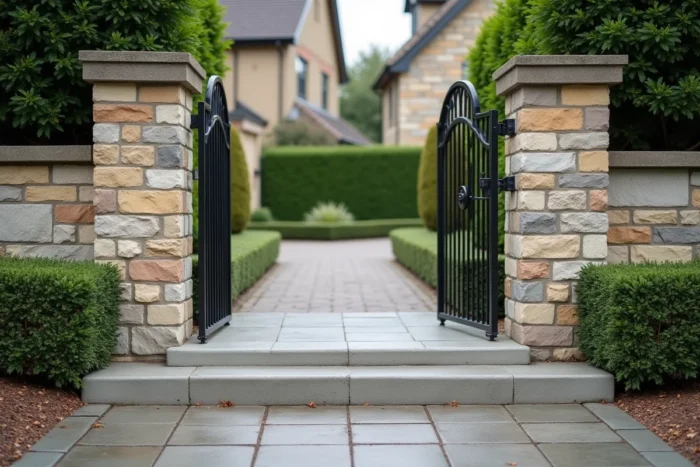
For a sliding gate, the flatness of the threshold is critical. A level defect, even minimal, causes premature wear of the rail and guiding rollers. Check the flatness with a mason’s rule along the entire length of the rail before considering the job complete.
The expansion joint between the threshold and the pillars deserves special attention. A flexible polyurethane sealant, applied on a joint backing, absorbs differential movements without cracking. A rigid or absent joint concentrates stresses and systematically reopens a crack at the junction point.
A successful threshold repair relies less on the choice of product than on the rigor of the initial diagnosis and the upstream water management. A well-drained, properly shaped, and surface-protected threshold withstands freeze-thaw cycles without degrading, whereas a simple crack filling fails by the next season.