
The displayed discount of 78% on Armor Lux items at Intermarché deserves a technical review before triggering the collection of stickers. This percentage, calculated on the recommended retail price by Armor Lux and not on an Intermarché shelf price, significantly alters the analysis of the actual value for money. Understanding this mechanism helps avoid overestimating the actual savings at the checkout.
Armor Lux Discount at Intermarché: Calculation Basis and Actual Price Paid
We regularly observe this discrepancy in large retail sticker operations. The recommended retail price (RRP) of an Armor Lux item, the one displayed on the brand’s website or in-store, serves as a reference for announcing the discount. The final price in Intermarché, once the stickers are deducted, remains attractive, but the relevant comparison is with the price you would have paid in an outlet or during sales directly at Armor Lux.
Specifically, a marine bag with an RRP of around sixty euros can be found at a reduced price at Intermarché with the sticker supplement. The actual discount compared to the sale price in the Armor Lux store is then more modest than the announced 78%. For everything you need to know about Armor Lux at Intermarché, this distinction between RRP and market price is the first filter to apply.
The discount applies to the recommended retail price, not to the sale or outlet price. This is a nuance that promotional communication never highlights.
Accumulating Armor Lux Stickers: Drive vs. Store
The attribution mechanism relies on the Intermarché loyalty card: one sticker for every ten euros spent. What changes depending on the channel is the ease of accumulation and opportunities for bonus stickers.

In physical stores, occasional promotions (double stickers on certain shelves, flash offers at the end of the week) allow for faster accumulation. At the drive, accumulation works as long as the loyalty card is correctly linked to the online account. This technical detail regularly blocks customers who discover, after several orders, that their stickers have not been credited.
- Check in the Intermarché app that the drive account and loyalty card are linked before the first order of the operation
- Prefer in-store visits during weeks when bonus stickers are offered on targeted categories (fresh products, beverages, hygiene depending on the periods)
- Combine drive and store on the same card to add up stickers without losing accumulation
The time needed to fill a collector directly depends on the average weekly basket. A household spending around a hundred euros per week accumulates about ten stickers. Filling a complete collector takes several weeks of regular shopping, making the operation more suited to loyal customers than occasional buyers.
Armor Lux Stock in Intermarché: Disparities Between Stores
Not all Intermarché stores participate in the operation. We recommend checking the eligibility of the local store before starting to collect; otherwise, the filled collector becomes useless if the usual store is not involved.
Each store manages its own supply of Armor Lux items. Field reports confirm that stockouts affect certain items from the first weeks, particularly beach towels and marine bags. Stores in coastal or tourist areas experience higher pressure on these references.
There is no centralized reservation system. Once an item is out of stock, restocking depends on local logistics, and no guarantee is given for a return to the shelves. The most reliable strategy is to identify the targeted item as soon as the operation launches and check its availability in-store even before completing the collector.
Which Armor Lux Items Are Worth the Actual Cost at Intermarché
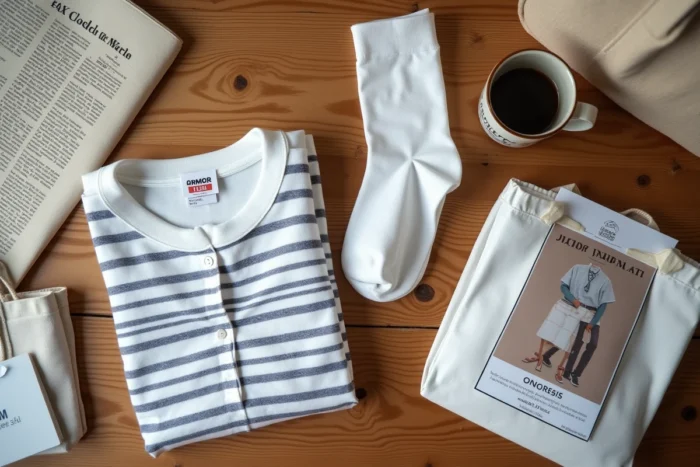
The offered collection includes accessories (pouch, insulated bottle, fouta, children’s poncho) and luggage (backpack, marine bag, travel bag, cabin suitcase). All bear the Armor Lux branding, but they are not textile pieces from the historical range (cotton striped shirts, cabans).
The most coherent price positioning concerns items with a low unit cost. The insulated bottle and fouta, accessible with a limited number of stickers, offer a more transparent value for money than the luggage whose RRP serves as the basis for an inflated discount.
- Insulated bottle: functional item, modest final cost, guaranteed daily use
- Armor Lux fouta: lightweight textile, correct weight for beach use, reasonable entry price with stickers
- Marine bag: the most sought-after item, frequent stockouts, actual discount to compare with outlet prices before committing
- Cabin suitcase: the highest final cost in the collection, requires a full collector, limited interest if you find luggage promotions elsewhere
The labeled items are designed for everyday use, not for technical luggage. The cabin suitcase and travel bag do not compete with specialized brands in terms of structure and durability, but they fulfill their function for occasional travel.
Armor Lux Sticker Operation 2026: Schedule and Trade-offs
The operation runs from May 12 to August 2, 2026. This nearly three-month window allows time to accumulate stickers without forcing the basket, provided you do not target the most coveted items at the end of the period when stocks dwindle.
The trade-off boils down to a simple question: does the time spent collecting stickers and the total amount spent on shopping justify the actual savings on the targeted item? For a household that is already a regular Intermarché customer, the operation does not change the grocery budget, and the stickers accumulate naturally. For someone who would switch stores specifically for this operation, the calculation becomes less favorable.
The right reflex remains to compare the final price of the Armor Lux item (collector price + any additional euros) with its price on sale or in an outlet. If the difference justifies the effort of collection, the operation delivers on its promise. Otherwise, Intermarché Armor Lux stickers remain a bonus for loyal customers, not a reason to switch stores.