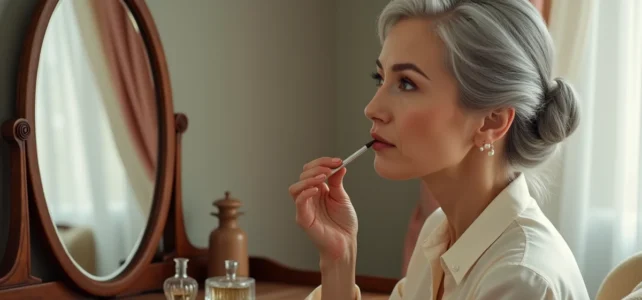
When applying a liquid foundation in the morning and it marks every crease on the face two hours later, the problem does not lie with the product. It comes from what we did (or didn’t do) beforehand. Makeup after 60 relies on a different logic than what was applied at 40: less product, more preparation, and targeted actions on the areas that catch the light.
Skin Preparation Before Makeup: The Step Most Women Underestimate After 60
The hormonal drop alters the skin’s structure deeply. Increased dryness, loss of elasticity, sensitivity to friction: these changes make hydration before makeup non-negotiable. Without this step, any product applied afterward clings to dry areas and visually deepens wrinkles instead of softening them.
We are talking about targeted hydration here, not just a quick gesture. Apply a moisturizer suitable for mature skin, wait a few minutes for it to absorb, then pat a smoothing treatment on the most marked areas (eye contour, nasolabial folds, forehead). This waiting time changes everything about makeup longevity.
Opinions vary on this point, but many women find that replacing their classic foundation with a rich hydrating treatment yields a more natural result. The goal is not to create a barrier between the skin and the foundation, but to smooth the skin texture so that the product glides instead of settling into the creases.
To delve deeper into these techniques with makeup after 60 tips and tricks tailored to each skin type, one saves valuable time in their routine.
Foundation and Concealer After 60: Lighten Rather Than Cover
The main mistake observed in the field is not the wrong shade choice. It’s the quantity. In recent years, professionals specializing in skin over 50 have emphasized a clear shift: reduce layers of product to avoid a caked effect that accentuates every wrinkle.
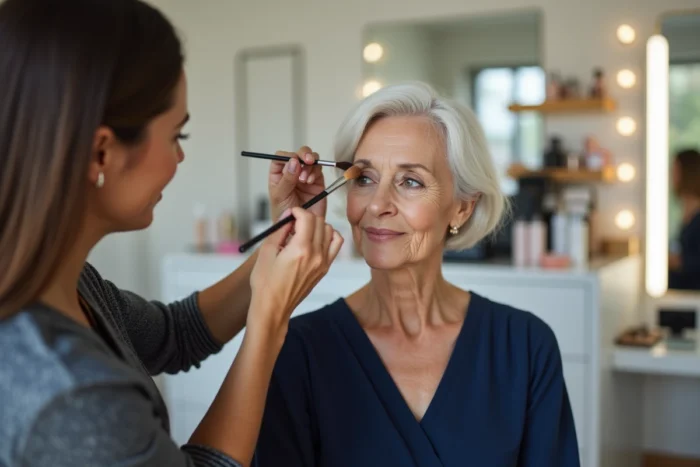
Specifically, we abandon heavy foundation in favor of a fluid product, or even a tinted moisturizer. It is applied in small dabs with the fingers or a damp sponge, starting from the center of the face and moving outward. The warmth of the fingers helps the product melt into the skin.
For brown spots or localized redness, a concealer applied only to the affected area is sufficient. Tap without stretching, because rubbing on mature skin moves the product and creates visible lines.
The Concealer Without a Cardboard Effect
The eye contour is the thinnest area of the face and the one that dehydrates the fastest. A concealer that is too thick or too light turns dark circles into white patches on skin that has lost density. Choose a shade just slightly lighter than the foundation, and apply it in an inverted triangle under the eye, in minimal quantity.
Eye and Eyebrow Makeup: Restructuring the Look Without Overloading
With eyelids losing firmness, creamy or powdered eyeshadows no longer hold the same way. The product migrates into the eyelid crease within a few hours. A specific eyeshadow primer solves this problem in most cases.
In terms of colors, matte and neutral shades (taupe, soft brown, rosy beige) enhance the look without drawing attention to sagging skin. Shimmery or glittery shadows highlight every fine line on the eyelid. They can be reserved for the inner corner of the eye, as a touch of light.
- Sparse Eyebrows: A fine-tipped eyebrow pencil, used in small strokes in the direction of hair growth, reshapes the arch without a “marker” effect. Choose a shade close to your natural color or slightly lighter.
- Mascara: One coat is sufficient after 60. A lengthening mascara rather than a volumizing one avoids weighing down lashes that have lost density. Focus on the upper lashes starting from the root.
- Eyeliner: If wearing glasses, a fine line along the upper lashes enlarges the look behind the lenses. A thick line has the opposite effect and visually closes the eye.
Blush and Lips: The Two Areas That Refresh a Face in Seconds
Blush is probably the most underused product after 60, even though it transforms a tired complexion into an immediate healthy glow. Apply it on the top of the cheekbone, not in the hollow of the cheek, to visually lift the oval of the face.
Cream or liquid textures blend better with mature skin than powders, which dry out and emphasize enlarged pores. Two small dots of cream blush tapped with the fingers give a more natural result than a brush loaded with powder.
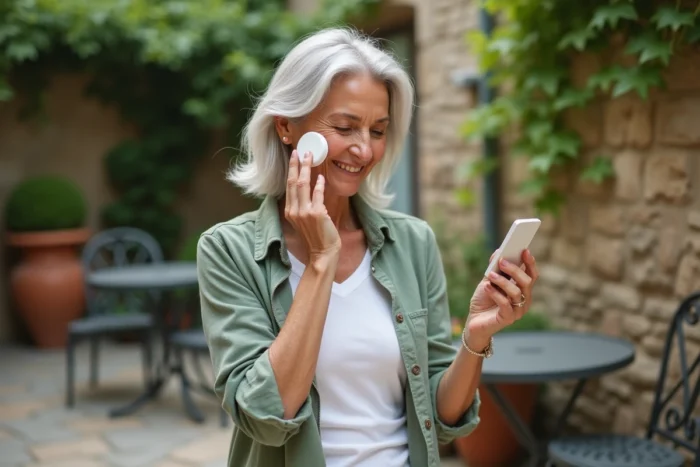
Lip Makeup After 60
Lips thin out and lose their sharp contour with age. A lip pencil in the same shade as the lipstick (not darker) redefines the contour without creating an artificial line. Draw just at the natural edge of the lip, without cheating outward.
Ultra-pigmented matte lipsticks accentuate vertical fine lines around the mouth. Satin or slightly glossy formulas are preferred, as they reflect light and add volume. Pink, coral, or berry shades soften features more effectively than very dark colors.
- Apply a hydrating balm on the lips before lipstick, to prevent the product from “bleeding” into fine lines around the mouth.
- Set the result by pressing a thin tissue on the lips, then reapply a thin layer. The longevity doubles without overloading.
- Avoid very thick glosses that easily migrate outside the lip contour on mature skin.
Makeup after 60 is not a diluted version of what was done before. It is makeup that focuses on the skin rather than the products, on light rather than coverage. The less you apply, the fresher and more natural the result appears, provided that each gesture is placed in the right spot.