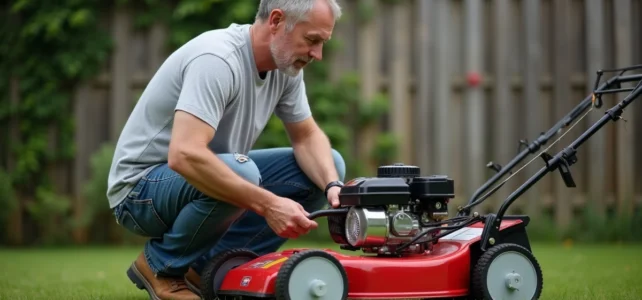
On a sloped lawn with grass up to mid-calf, you quickly find yourself with a mower that stalls every three minutes. The natural reflex is to check the engine displacement on the technical sheet and think that a 190 cm³ engine will definitely be more powerful than a 140 cm³.
The reality is more complicated: two engines of the same displacement can deliver very different powers depending on their architecture, speed, and distribution technology. Understanding the relationship between cm³ and horsepower helps avoid buying an undersized machine or paying for cubic centimeters that are of no use.
Why displacement alone does not predict a mower’s power
Displacement (cm³) measures the volume swept by the piston in the cylinder. It’s a geometric data point, not a performance metric. Horsepower (CV) depends on the thermal efficiency of the engine, the rotational speed, and the type of distribution.
An OHV (overhead valve) engine of 160 cm³ can produce as much useful power as an older side-valve engine of 190 cm³. More recent OHC (overhead cam) engines push efficiency even further. We are comparing a theoretical volume to real energy, which is akin to comparing the size of a tank to the flow rate of a faucet.
For push mowers, a single-cylinder engine of 125 to 190 cm³ typically ranges from 2 to 6 CV depending on the technology. For lawn tractors, an engine of 400 to 450 cm³ often delivers around 9.5 to 12 CV, but some more modern models of the same displacement achieve significantly higher power thanks to better efficiency.
To navigate this, you can consult a cm3 to horsepower chart for mowers that compares common displacements and their equivalents in CV based on the type of engine.
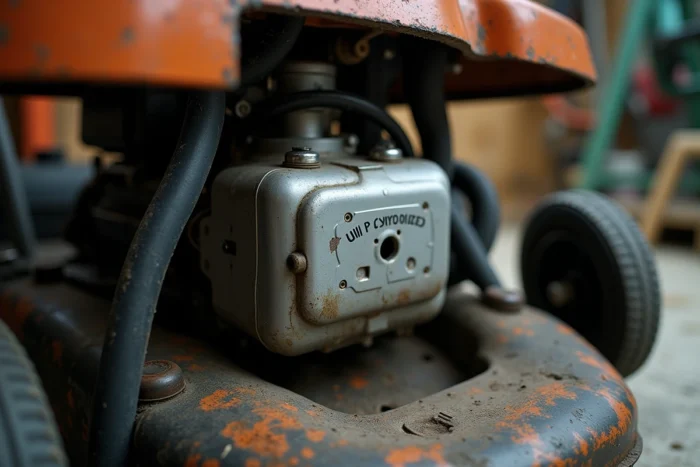
Single-cylinder or twin-cylinder: the parameter not highlighted in the technical sheet
On lawn tractors, you find single-cylinders and twin-cylinders in the same displacement range. The difference in performance is clear.
A twin-cylinder offers more usable torque at low speeds, less vibration, and better handling in tall grass. When tackling rough terrain or areas where the grass exceeds 15 cm, the single-cylinder tends to lose speed and strain the blade. The twin-cylinder maintains its rotational speed more consistently.
Feedback varies on this point depending on the brands, but the general trend is clear: at equal displacement, the direct comparison of cm³ to CV becomes even more misleading if the number of cylinders is not taken into account. Two 450 cm³ engines may show the same horsepower on paper while behaving very differently on a grassy slope.
kW to CV conversion: the formula to know for reading technical sheets
Most mower manufacturers now display power in kilowatts (kW) rather than horsepower, in accordance with European standards. The conversion is straightforward:
- 1 kW = 1.36 CV (rounded from 1.3596). To convert from kW to horsepower, multiply the kW value by 1.36
- In the other direction, 1 CV = 0.7355 kW. An engine rated at 5 CV delivers about 3.7 kW
- This equivalence pertains to DIN horsepower (actual mechanical power), which should not be confused with fiscal horsepower used for car registration documents, which follows an administrative calculation unrelated to actual power
When a technical sheet indicates 7.1 kW for a lawn tractor, it equates to about 9.6 CV. This is the figure that matters for sizing the machine, not the raw displacement.
Reading a mower’s technical sheet without making mistakes
Three pieces of information should be cross-referenced before purchase:
- The net power in kW (or CV), measured at the engine’s nominal speed
- The displacement in cm³, which gives an indication of the mechanical size but not of performance
- The type of distribution (OHV, OHC) and the number of cylinders, which determine actual efficiency and load behavior
An OHV engine of 190 cm³ with 3.5 kW and an OHC engine of 160 cm³ with 3.5 kW deliver the same power. The latter is often lighter, more fuel-efficient, and quieter. The power in kW is the only directly comparable figure from one model to another.

Lawn area and cutting width: the real criteria for choice
Recent buying guides for lawn tractors emphasize sizing by lawn area and cutting width more than displacement or raw CV. For a lawn area of about 4,000 m², recommendations point towards a lawn tractor with a cutting deck of 95 to 110 cm and an engine of 12.5 to 16 CV.
Displacement is mentioned only as a guideline, not as a primary criterion. This makes sense: the cutting width determines mowing time, while power determines the ability to maintain blade speed in dense grass or on a slope.
Adapting power to the type of terrain
On flat terrain with weekly mowing, a modest engine is sufficient. Power becomes a decisive factor when the terrain accumulates multiple constraints: slope, tall grass, wet soil, frequent obstacles that require maneuvering.
For push mowers on areas less than 500 m², an OHV engine of 125 to 160 cm³ covers most situations. Beyond that, or if you regularly let the grass grow tall, you should aim for a higher displacement, but above all, check that the advertised net power matches actual needs.
Converting cm³ to horsepower remains a useful shortcut for navigating ranges, as long as you don’t rely on it blindly. Engine technology, the number of cylinders, and cutting width weigh as much, if not more, than the raw volume of the cylinder. A well-designed engine of modest displacement often outperforms an old large block in user comfort and cutting efficiency.