
Organizing a stress-free wedding rarely starts with a list of vendors or a budget spreadsheet. The real starting point is a clear agreement between the two partners on what they want to experience that day and what they are willing to set aside. Without this foundation, every decision becomes a negotiation ground, and the pressure builds well before the big day.
Wedding Financing: Clarify Who Pays for What Before Any Booking
Have you noticed that the budget question crystallizes more tension than the choice of venue or dress? It’s because it touches on both finances and family dynamics.
Customs have changed. Today, the couple finances between 50% and 70% of the wedding from their own savings. Parents often contribute to specific areas (catering, flowers, drinks), but rarely to the whole. This financial autonomy simplifies some decisions, as the couple retains control. However, it requires setting a realistic ceiling from the start.
Before signing any quote, ask three simple questions: what is the maximum amount you are willing to commit without credit? What areas are priorities for both of you? And what external contributions are confirmed, not just mentioned? A budget based on these answers avoids unpleasant surprises three months before the ceremony.
To structure this step and all the following ones, the organization on the La mariée de Sophie website details the milestones to be respected month by month, from the initial budget to the final adjustments.
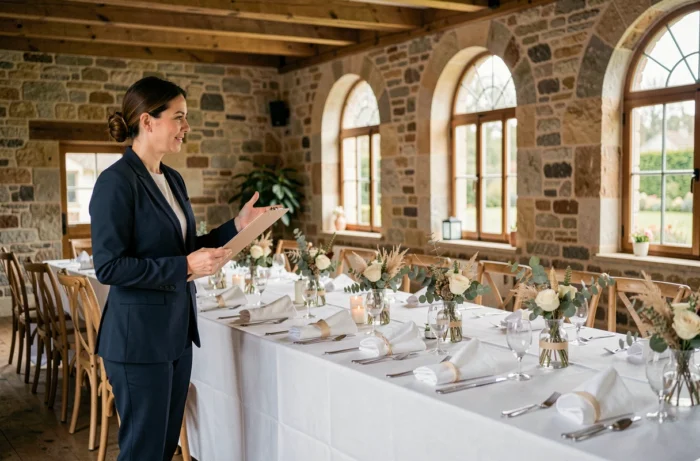
Slow Wedding: Spreading Out the Festivities to Relieve Pressure
Concentrating all the emotional and logistical load on a single day is the classic model, but it is no longer the only one. The trend of slow wedding, a wedding spread over two or three days, is gaining ground in France. The principle: slow down the pace so that each moment is fully experienced, not endured in urgency.
A Working Format
- On Friday evening, an intimate dinner or welcome party brings together close friends who arrived the day before, in a relaxed atmosphere without protocol
- On Saturday, the morning remains free (calm preparations, no early wake-up), with the ceremony scheduled for late afternoon
- On Sunday, a prolonged brunch wraps up the weekend, and more than half of couples surveyed in a Hyatt study now wish for this extension
This format doesn’t necessarily cost much more if the accommodation venue is the same. It redistributes expenses differently: less pressure on Saturday evening, more time shared with guests. The logistical stress of the big day decreases mechanically when reunions have already taken place the day before.
Choosing Vendors: Three Criteria More Reliable Than Online Reviews
Most guides advise to “choose your vendors wisely.” But a good vendor for one couple may be unsuitable for yours. The perfect photographer for a wedding of 150 people in a castle will not be the same for a secular ceremony with 40 guests outdoors.
What Really Matters in the Choice
The first criterion is responsiveness. A vendor who takes ten days to respond during the quoting phase will likely take the same time to confirm a logistical detail a week before the wedding. This is not a sign of artistic quality; it’s a direct stress factor.
The second criterion is the clarity of the contract. A detailed quote item by item protects better than a vague flat rate. Ensure that cancellation conditions, overtime charges, and travel expenses are explicitly stated.
The third criterion, often overlooked: human compatibility. You will exchange dozens of messages with your caterer, DJ, and florist. If the chemistry doesn’t click at the first meeting, it won’t improve under pressure on the day of the ceremony.

Managing Guests and Unforeseen Events on the Wedding Day
Why do so many newlyweds say they “endured” their own day? Because they remained the sole point of contact for every question, from table placement to sound system breakdown.
Designate a relay person who is not one of the newlyweds. A witness, an organized friend, or a day coordinator. This person receives a sheet with the schedule, the phone numbers of the vendors, and the list of decisions already made. If a guest arrives late or if the caterer has a question, they handle it.
Also prepare a small practical first aid kit: safety pins, band-aids, phone charger, pain relievers, and a spare set of rings entrusted to the witness. These are details, but every anticipated unforeseen event is a spike of stress avoided on the big day.
Finally, accept that one or two details will not be perfect. The slightly off-center centerpiece, the cousin who gives a too-long speech: these micro-incidents are part of the memory. They don’t ruin anything if you have decided in advance not to let them take center stage.
A successful wedding is not a perfect wedding. It is a wedding where the two people saying yes have time to look at each other, smile, and enjoy those they love. Everything else is logistics, and logistics can be delegated.


