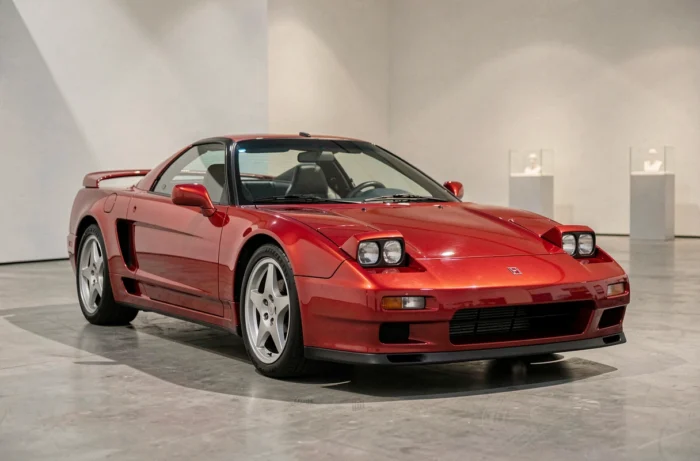
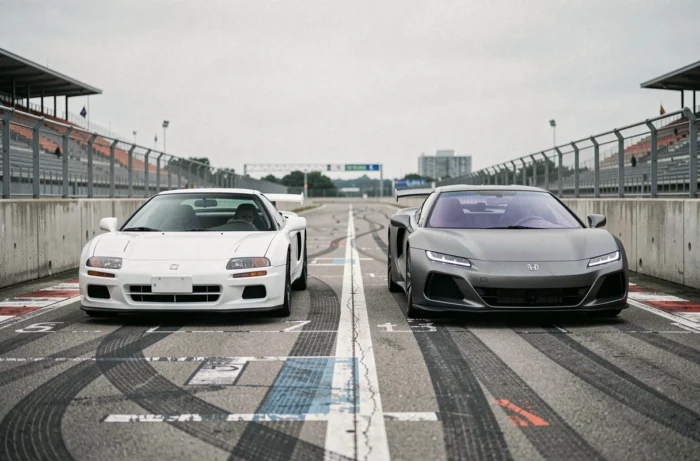
The Honda NSX refers to two sports cars separated by more than twenty years of development. The first generation, produced from 1990 to 2005, features a naturally aspirated V6 engine with VTEC distribution mounted in a rear mid-engine position. The second, marketed from 2016 and whose production ended with the limited edition Type S, adopts a hybrid architecture with three electric motors coupled with a twin-turbo V6.
These are not two versions of the same car, but two distinct technical philosophies bearing the same name.
Transmission and hybrid architecture: the real divide between the two NSXs
The most significant divide between the two generations lies in the transmission and power management.
The first-generation NSX transmits its power to the rear wheels only via a five-speed manual gearbox (later six-speed on later versions) or a four-speed automatic transmission. The architecture remains classic for a mid-engine sports car: a naturally aspirated V6, a clutch, a rear differential. The driving experience relies entirely on the driver, without electronic vectoring assistance.
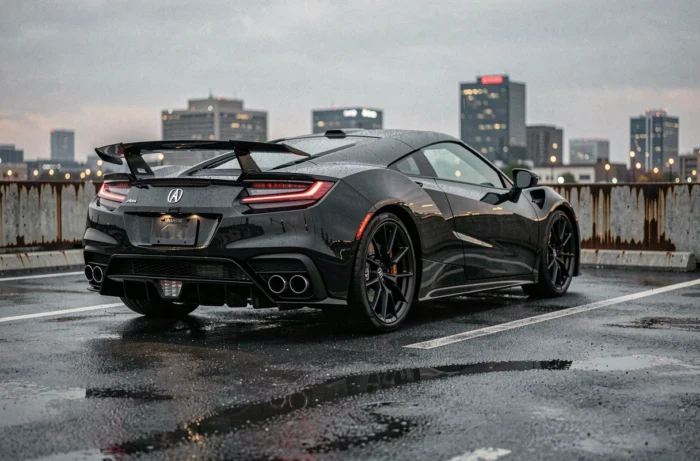
The 3.5-liter twin-turbo V6 of the second generation drives the rear wheels through a nine-speed dual-clutch transmission. Two independent electric motors power each front wheel thanks to the SH-AWD (Super Handling All-Wheel Drive) system.
In corners, the electric motor of the outer wheel accelerates while the inner wheel’s motor brakes, altering the trajectory without driver intervention. A third electric motor, positioned between the V6 and the transmission, fills the turbo response time.
An article detailing the differences on La Belle Auto allows for a deeper exploration of each point in this technical comparison generation by generation.
Naturally aspirated engine vs hybrid twin-turbo V6: two approaches to power
The V6 of the first NSX (engine code C30A, then C32B from 1997) develops its power linearly up to high revs. The VTEC system alters the cam profile at a specific RPM threshold, causing a strong power surge at high revs. This direct and progressive mechanical response remains one of the most cited characteristics by owners and testers of the time.
The second generation produces a significantly higher combined power but delivers it differently. The maximum torque of the twin-turbo V6 arrives earlier in the RPM range due to the forced induction. The electric motors provide an instant boost from low revs, and the driving sensation resembles a constant push rather than a crescendo.
The feel beyond power figures
The difference in feel goes beyond power figures. In the first NSX, the driver perceives every mechanical phase: the engagement of VTEC, the rise in revs, the manual gear shift. The second generation smooths these transitions through electronics and supporting electric motors.
This is neither a flaw nor an absolute improvement. The old NSX offers a rare mechanical transparency, while the new one prioritizes measurable efficiency and versatility of use, including in fully electric mode at low speeds.
Aluminum chassis and construction: a shared technical advance two decades apart
In 1990, Honda introduced an all-aluminum monocoque chassis on the NSX, a first for a production car in this category. This choice reduces weight compared to an equivalent steel chassis and improves structural rigidity. The double-wishbone suspension on all four wheels complements this foundation.
The second generation retains a multi-material structure chassis incorporating aluminum, but adds ultra-high-strength steel reinforcements and carbon fiber elements (floor, some panels). The weight increases significantly compared to the first generation, due to the lithium-ion battery, the three electric motors, and the all-wheel drive system.
- First-generation NSX: aluminum monocoque, rear-wheel drive, weight kept low due to the absence of hybrid components
- Second-generation NSX: multi-material structure, hybrid SH-AWD all-wheel drive, weight increased by the electrical system
- Both generations share the rear mid-engine position and a double-wishbone suspension
Value and market in 2026: two distinct value trajectories
With the end of production of the second generation and the conclusion of the Type S series, both NSXs now evolve exclusively in the used car market. Their valuation follows very different logics.
The first generation fully enters the collector category. According to data relayed by Hagerty and specialized analysts like classic-analytics, documented examples with complete history stand out significantly from commonly used models. Individual provenance weighs as much as the generation: Ayrton Senna’s personal NSX, announced for auction by RM Sotheby’s, reaches a much higher estimate than a standard NSX of the same year.
The second generation experiences an inverse trajectory. Still recent, it suffers the typical depreciation of used prestige sports cars, with prices significantly lower than the new catalog price. Its maintenance costs, although considered reasonable compared to European competitors in the same segment, remain higher than those of the purely mechanical first generation.
What pushes an example into the collector category
For the first-generation NSX, the determining criteria are mileage, the presence of a manual gearbox, the absence of modifications, and complete maintenance traceability. The Japanese Type R versions and the last Type S occupy the top of the valuations.
For the second generation, the limited production Type S could follow a similar path in the medium term, but the complexity of its hybrid system poses an unknown for long-term valuation.
Two cars, one name, and yet two automotive objects that almost everything separates. The old NSX remains an analog sports car whose value rises with rarity. The new one embodies a technological approach that has yet to find its definitive place in the collector market.


